The Scottish scenario and other projects

This one is a bit of a feat for me, getting a result I was happy with from painting a pre slotta figure. One of the issues with the early figures is that they are often quite crudely sculpted or lack detail, so you need to allow for that when painting them. They often do have quite a lot of charm though, and follow an early aesthetic before the more cohesive army/Warhammer designs.

This is one of several figures I have in preparation (repaired and undercoated) that were broken or had missing parts. I had to find another sword blade for him (removed from a plastic Wargames Atlantic sprue). He is supposedly an elf or possibly half elf adventurer, I quite like his rather blank gormless expression and Tim from the Office hair. Incidentally separate plastic shields are much less of a ball ache than the moulded on ones.

IMG_3974.jpg
 
I think some aren't as crude sculpts as people think, but there is a degree of being softer and the age. It's like if you watch all them TV shows and films set during WWII, you would think 78 records sound all scratchy and pop-fulled. But that's is playing them on more modern tech, with the years of dirt and warping. If you have a good copy played on even half-way decent tech in good nick, there is no real problem. Which has warped peoples views on the quality.

Again, alot of the old softer materials (like the higher lead content) has lead them to soften a bit more and slightly warp. That said, depending on the sculptor and stuff, earlier ones were often made in materials which didn't hold detail as well, or they were still learning etc. while they are nice, Alot of Asgard miniatures do show how early it was for some sculptors.
 
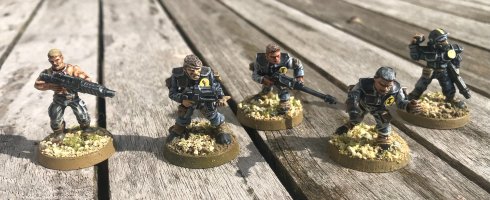
Finished my first Imperial Guard Squad. Really happy with these, really want to actually use these in a game. They're a mix of actual metal and plastic Citadel Imperial Guard (and the Imperial Army models that preceded them), a Space Pirate, a Chainsaw Warrior figure with the rocket launcher and a few aftermarket composite figures (heads, torsos and legs by Spellcrow, arms by Anvil Industry and a single modern Citadel head). I did buy the stripped to the waist models hoping to do a few Rogue Trooper inspired figures using the plastic Imperial Guard helmeted heads but they're massive so I might need to find something else to do that.

IMG_3979.jpg
IMG_3978.jpg

I wanted to go for the sort of irregular look, like Guardsmen recruited from hive or feral worlds still clinging on to their old identities.
 
A very entertaining thread - I've just had a read through. Extra bonus points for the Ace Rimmer reference.

All your mini's look excellent!
 
A very entertaining thread - I've just had a read through. Extra bonus points for the Ace Rimmer reference.

All your mini's look excellent!
Thank you, everyone is very kind and encouraging. It really has boosted my painted output having somewhere to display them.

I do have a set of very well sculpted white metal Red Dwarf miniatures somewhere, they were done by a short lived rather obscure company several years ago. I don't think the set actually had an Ace Rimmer, but did have a holo virus version complete with gingham dress and Mr Flibble. They'd make a fantastic addition to a Rogue Trader era scenario.
 
as not a history student but with a number of interests with Saxons (or more Anglo-Saxons due to local history)... Blue is an interesting choice for footsoliders. It looks good but whoa, they are rich boyes
 
yep, no problem.

Historical, blue pigments have been somewhat rarer and used as a symbol of wealth and royalty. The Egyptians used it for the high ranking and pharaohs as pigment on the gold to give the standard gold/blue scheme we think of with the pharaohs, this was Egyptian blue and believed to be one of the first synthetic pigments. It was a bit of stuff with copper and calcium but I can't say the full mix.. not my field ^_^ The Maya had there Maya Blue which was amazingly resistance to the elements as even the worse of weathered stuff, often has the blues unfaded.

During the more 'Medieval' area, the only real way they had of manually dying clothing blue, was using Woad. There are... theories that Woad was used for the Picts (the Pictured people) but the evidence is.. interestingly missing we know a group referred to be the Romans as painted or tattooed people, though the word used to describe the colour is more a blue/green which were pretty common at the time, and wouldn't really be what many of us would call Blue, it's just later on the term was applied to Blue (Vitrum isn't latin for Blue but glass, Woad is caustic so tattoo tests these days have been... poor and historical finds hint they used a copper base) (in the same way as in Japan, the word for Green and the word for Blue was the same until quite recently they created a new word for Green. This is why anyone that has watched Japanese animation and you see a traffic light which is Blue instead of green, it's kinda a hold back because of that. It was a mistake done soo long ago and soo often that it's kinda a cultural point now).

That said, what is known of Anglo-saxon clothing they would use a mixture between natural colours (of the wool and stuff) but also did some dying. Mostly, these were bad jobs and the more money you had, the better the dye job and colour. the Poor would have a bit uneven and a bit washed out over time, where the richer, the 'richer' the colour, which is why we see in art and samples of clothing from the time have things like strong reds, blues and even purer whites and greens with the higher ranking, and anyone with a bit of money for social climbing. That isn't to say the poor folks would be stuck with just browns, off-whites etc.

There is also a matter of tastes. Alot of the Danes loved Red, so they used that alot. the Irish loved purples (green for the Irish is a weird modern thing.. Hell, in old traditions, leprechauns wore Red, until more recent times when it was changed to Green.

In more modern times, around 500AD, the French royal family used Blue (Royal blue) as a ranking colour to show the king, which was thus used for the King's Guard's uniform, the Musketeers, and even up to WW1, until the days of the need for Camouflage. Much more modern, we have a weird indigo colour which is called Saxon Blue, but that was 1700s.

While my knowledge isn't 100% of course, soo many cultures used and still use Blue for a richer classes. In fantasy, do what ever you like, But historically, It wasn't a huge colour for the peasants for quite some time. Like I said, I'm more coming at this from an Anglo-Saxon point, after the Saxon's have come to England and started to mix, but before the arrival of the Normans, who would have suppressed Blue for the lower classes as they have it still firmly for their royals.

Of course, I'm still not a HUGE expert. I know Woad trade became a big thing for a while, till it was replaced, but again, lower grades wouldn't have access to alot and well, atleast these days, it's a really rare plant in the UK. How common it would have been else where, short of from trading (Vikings had a trade in it I believe) I'm not sure.

So, that's basically why I think of it more as a rich boye colour and interesting choice if you are aiming for more historically accurate. But I'll be interested if people know a bit more on the history of early Medieval dying and textiles.

 
@ManicMan. The archaeological evidence is that woad was widely used during the early medieval period and persisted well into the early modern period when it was supplanted by other dyes. I don't think I've ever seen any evidence to suggest it was in of itself high status. You could of course buy higher quality clothing at a higher price, which would probably be dyed to a higher standard and which was more richly coloured. Bog standard clothing would be less vivid in colour and more prone to fading.

For mine I've gone for a combination of uniformity and historic accuracy. Most of my human McDeath footsoldiers are painted according to the schemes in the scenario illustrations, which for the clansmen is basically blue. I choose a blue theme for any additional figures to tie them in to this theme (see the elven sorceress on the first page of this thread). I chose a much more washed out greyish blue or grey hue for the Saxon figures, mainly by way of experimentation.

The extent to which early medieval people wore bright colours or for example had brightly coloured shield designs is a long running debate, especially amongst re-enactors (several of my colleagues take part in early medieval re-enactment). People weren't necessarily as destitute and downtrodden as the common perception has it, so things like personal appearance and material culture were of great significance. My personal view of the Saxon 'invasion' is that comprised a highly pervasive minority subculture that somehow managed an disproportionate influence on the existing British (Brythonnic) majority over time. A nice parallel equivalent to this would be for example how various minority cultural and ethnic groups in modern Britain have affected mainstream language and culture, so youth culture is hugely influenced by African, African American or Afro-Caribbean language, music and fashions and has been since the 1950s.
 
as said, I was more on the Anglo-saxon side, and I know in the late 11th century, alot of woad was imported from Saxony, with the Anglo-saxon period generally being 450 - 1066, when the Normans invaded. Do you have any references to a rich blue for a Saxon peasant at the time?

I know the indigo woad fragments at Sutton Hoo, but they are far from the peasant gear. We have, as far as I am aware, no evidence of HOW medieval woad dying was done, and kinda evidence that it wasn't ever used as a skin paint/tattoo.

Yeah, I do notice alot of people think people were always soo down trodden all the time and so poor while the rich got richer.. kinda 'grim dark' feel which I never liked. the average person had an average life.

I'm pretty happy to learn as that's one of the main things to do in life.

Oh and I would have put culture mixing pot long before the 1950s. people like to tot the HMT Empire Windrush as some major thing, when that trip was common BEFORE it, even if there was an increase with it and other ships (why they just pick on that one I have no clue) to help restock after WW2, but such mixing practices were common before that with alot of 'British' culture coming from other influences before.

I think current 'youth' culture is just influence by being gits ^_^
 
I'm gonna un de-rail this thread and say your work looks great fella. That witch fig at the beginning of the thread looks dead gorgeous.
Please dont feel like you have to interact with all of the crazy, manic comments. Many of us don't.

I wanna see more! x
I absolutely love that witch figure, especially the cat. I do need to acquire some more witches for a proper coven, might even work out some rules for them.

Thank you, I will post my whole collection at some point. I was feeling very happy with how they look, some of these were painted nearly fifteen years ago. I'm not sure if my technique has improved since then, but it makes me happy (miniature painting is so relaxing and destresses me enormously, plus you get that lovely warm glow of satisfaction when a figure is completed).
 
unnamed.jpg

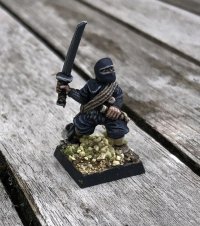
This is another figure that's spent the past 30 odd years languishing in a leadpile. He also lost a foot so I had to make him a new one out of greenstuff. Ninja(s?) were a fantasy staple in the 80s and 90s thanks to rpg games like Bushido and popular media properties and computer games.

Mine is another figure from the Dungeonquest set, and is one of the best ones they did, armed with a katana, and equipped with a rope and grapnel for sneaking into places with high walls. Apparently real life ninja didn't dress like this and tended to avoid dark colours like black, but I went for a compromise with a dark blue outfit for blending into shadows.
 
I see that the professional archaeologist forum members have not said anything negative about them.
Are there many other archaeologists on here besides me? I know Orlygg on Realms of Chaos was a archaeologist, and quite a few GW alumni were also archaeologists (I recently found a site report from the early 80s written by an N. Stillman whilst researching a job online).
 
Back
Top