2nd or 3rd

Y'know, some would say that was the beginning of the end. Balanced, restrictive lists that paved the way for the competetive dynamics of 4th onwards at a cost to the narratives of 1st and 2nd.
[Apologies for rambling here :D]
I would totally agree, a seismic shift to almost (shall I dare say) to a coercive this is HOW you must do it, 'chess-like' game play rather than "OK wot you got? Put it on the table, lets make a fun backstorey, let's roll dice and play". It's telling how many of the original Citadel/GW creatives/makers stepped away from it at some point and when you read their disappointment or latent rejection of the system(s), certain people's calculated business decisions and development direction in later years. For instance Chalk on WHFB, Priestley on 40K...Rick Priestley is an interesting person in a sense he defined 'it' (warhammer) as a wargame, and has subsequently made more (and been successful), but always seems to be true to that ethos of 'rock up, see what you got, and let's play with it'. Even if the minis aren't from our range or whatever! Proper oldhammer gaming and that he still meets his old GW mates to play! Wonder if you could say that about the current GW top table? :D

Anyhow, not that I am disparaging with later rules/list/codexes, but they are a turn off. My idea is the original WHFB 1e and 2e rules seemed a foundation only and just for moving a few toy soldiers (what we could afford, accumulate or share between us) around with my mates, usually as story driven skirmish made up on the spot. With 1e then more 2efor us it felt it was more about spending time in a group of like minded friends and trying to get one over each other rather than any seriousness. We also socialised and talked shite, ribbed each other even the mates who was GMing it. Isn't that's what's gamings about? A release from reality (even historicals)? I certainly felt it was more freeform than sitting at table rpg'ing (also with miniatures) which also did a lot.

As an aside here (not saying to upset those that do) I've never really bought into the solo-play or the super detailed overloaded rules and historical exacting side of certain tabletop wargaming. Doesn't that defeat the object of gameplay, an unmade reality? Some rule systems obviously appeal to certain people with that mindset. But with solo play I guess that is a practical recourse to some if no players locally or those willing! I feel Warhammer was created to play (and have a laugh), and born from Halliwell's original rules. The first three editions you can see the spirit and soul of two mates, Halliwell and Priestley, coming together and sharing that ethos with us all, their love of fantasy and the ridiculous, like a weird extended student mates wargaming family. The Warhammer rules with their detachedness and veering from the usual percentile dice driven rpg and tabletop historical fraternity, made it super niche, but appealing all at the same time! :D Then I guess it got super serious as a business venture and with some impeccably adroit and well-timed decisions (ie personal changes, the fledgling UK gaming industry, plus Bryan Ansell's influence/lead) then in the late eighties, which, of course, was to sell miniatures and rules and a kind of reinvention continuum... Later, oh and back to massed ranks and formations and difficult movement/ manoeuvres (which I didn't sign up for fantasy)- save that for historicals!
 
well... carrying on that little ramble, I feel I really wanna quite this extract written in 2011 by Jim Shooter, one of the more successful EIC at Marvel Comics. For most of his time, Stan Lee wasn't interested much in Comics and was away with other related venters like Marvel Productions, and at the time it was when Cadence, a... not amazing business first company was in charge, so Shooter did alot of fighting with them in order to get some things done. He is seen as far more 'controversial' because of this. Anything bad, the writers, artists etc were just told 'It's shooters fault', anything good 'it's in spite of shooter'. but anyway.. back in.. this has to be early 1980s, about 1981, there were trying to do a deal with TSR. I've slightly edited this extract to make it a bit shorter:

At the appointed time, Gary Gygax showed up with several executives of his company, TSR, Inc. I don’t remember their names or all their exact roles, but one was the Chief Financial Officer and the others were V.P.’s of this or that. We met in Mike Hobson’s office, (...) it was spacious and accommodating.

Present from the Marvel side were Vince Karp, Mike, me, and three people from upstairs—the President, Jim Galton and the directors of domestic and international licensing (later they each became V.P.’s).

Gary and his troops talked about what they did. Gary struck me as a brilliant, clever and creative guy.

I was also impressed that his top executives, suit-and-tie business people types who wouldn’t look out of place at MetLife, all knew the game and played the game. They clearly loved D&D.

Then it was our turn to talk about what we did. Galton and the licensing people made it clear that they were far too dignified and sophisticated as human beings to ever read a comic book. They joked about not knowing anything about the comics.

I have to believe the TSR people had to be a little insulted. If Marvel’s execs thought that proper adult business people worried only about dollars and deals, that actually reading the books would be somehow embarrassing, then what might they be thinking of TSR’s game-playing execs?

At least Mike had a fair idea of what D&D was, and of course, Vince did. I tried to show that I was familiar, too, and talk about the comics positively. Gygax and I had common ground when it came to the value of story.

If Alice Donenfeld, our wonderful, super-smart V.P. of Business Affairs had been there, I guarantee she would have done her homework, and that might have balanced things a bit, but no such luck.

We all went to lunch. The Marvel people wanted to talk numbers, units, dollars and deals. I wanted to talk more with Gygax about his own story and his creative vision. We got a few exchanges in, not many. I liked the guy.

Nothing ever came of that meeting. I think it was because the attitude of our brass turned the TSR people off.

Kinda follows up with the view of how alot of the bigger companies have always been and how gaming companies become when they get big. Citadel is clearly in the 'Marvel' side now, as are what is now (for the moment) Hasbro D&D. Kinda the same thing happen with Atari when Tramiel took over. Oh and a few years later, they finally did get a deal, and the D&D cartoon happened.
 
I've always favored more improvised, more narrative games. I don't need the rules to be "crunchy" and to tell me where the model was injured and how long it took them to recover, and what scars they accumulated. I just need to know if they're in the fight or not; if they succeed when they try to jump across the ravine so they can get to the stash of magic rubies on the other side. I'm more of a story gamer than a war gamer. The leagues and tournaments that popped up with 40K 2nd edition never attracted me a bit. I just couldn't care less. Okay. Build your carefully crafted army. Have fun. Not for me, though. I want to paint miniatures that I think are interesting and just have fun. If I want a wargame, I can play historicals. (And I do every now and then. WWII naval, mostly, though fighting sail can be fun. And even then, I prefer a game that plays quickly and gives an approximate, but believable result to one that's slow and very exacting. If Hood v. Bismark is about 50/50 that's probably more than close enough. Give some advantage to good tactics, allow for some luck, and call it a day.)
 
I would totally agree, a seismic shift to almost (shall I dare say) to a coercive this is HOW you must do it, 'chess-like' game play rather than "OK wot you got?
I wonder (speculating out loud) if this is true of other product lines? LEGO for instance perhaps shifting more over time to much more defined characters and sets and less away from "a pile of bricks", especially with the rise of more specialist bricks to do specific jobs. That isn't to say that LEGO didn't release "sets" with a design in mind early on, but just that perhaps it's shifted somewhat maybe as they took on external IPs for instance.

Anyhow broadly I'd agree that as Warhammer evolved it did indeed become a much cleaner (for want of a better word) structure. Which isn't to take away from the fun of things (as I've mentioned before I think most of my WFB was 4/5th edition and I loved it). Even the newest stuff can be quite cool, I was flicking through WD today and the crazy somewhat steam punk weird walking towers for - I assume - Age of Sigmar, were rather funky models and I quite liked them. They didn't scream "warhammer" to me, but that's besides the point. Change isn't by default bad, it's change and it might mean I personally have less interest in the product (for example AoS), but evidenced somewhat by GW's stock price it's certainly not unpopular!
 
Change isn't by default bad, it's change and it might mean I personally have less interest in the product (for example AoS), but evidenced somewhat by GW's stock price it's certainly not unpopular!
Oh absolutely, but one wonders how much longer the kids /preteens/young persons, even twenty somethings, are gonna to be able to afford their plastics. Both Warhammer and Lego for that matter! It's like the companies are pricing themselves out of their core customers and with price rises, materials, energy prices etc on the perpetual rise also... It's not looking good. Majority of the kits aren't 'pocket money' /affordable/attainable anymore (like a single warhammer figure or tiny lego kit). Probably why some kids just go buy cheap games on steam for the pc or whatever. Also, most kids round here don't buy from the Warhammer shop, they go to Boyes which has gw goods in circa third price less, or the local independent gaming shop (also cheaper). They also know they aren't gonna get pestered with a hard sell within 30 seconds of entering, but browse (and dream) at will.
 
I was talking about gaming book prices with a friend the other day. She was surprised at the cost of a large, new gaming book of some seven or eight hundred pages, hardbound, and nicely printed. It was about $120 US. When Rogue Trader first came out, I simply couldn't justify the expense. My friend had a copy, so I didn't really need my own. I finally bought it when I was in college, some five years later. It still has the sticker on it. $29.99. Even in 1992 dollars that'd be north of $70 today. The hardback, when new, retailed for almost exactly the same thing as her fancy gaming book whose price surprised her. And it was less than half the length and not especially well printed. (I love it, but it had a reputation for falling apart, and quality control was always an issue.) GW and Citadel have never been pocket change. They've always charged a hefty premium in my experience. The same $30 would have bought me a decent model locomotive. It was 10% of my rent in 1992. It would have been a nice date; say dinner and a first run movie. It would have taken me to the symphony almost three times. (In the cheap seats, to be fair.) Kids have a fair bit of pocket change. I like Rogue Trade, but let's not kid ourselves. That stuff was expensive, even back then.
 
Citadel has been a little more expensive than pocket money for some time now… I really don’t think young kids are their target demographic. 🤔
Well, you can buy 'cheapish' kits, say, Boyes were selling the 40K runtherd and gretchin kit (11 models!) for under £12 at one point... Surely the demographic is kids/teens?!, skinning their parents (or elder relatives) to buy them warhammer stuff. If not affordable to preteens/teens (unless exceedingly rich!), then there is no legacy. At the very least a rapidly shrinking customer base. There's enough competition (trading cards etc) out there vying for their money. And surely middle age people with deep pockets aren't going keep the GW empire going indefinitely?! 😂
 
That stuff was expensive, even back then.
Well I'd disagree (to a point), although I am based in the UK. Mid eighties it was 'affordable'. A weekly comic like 2000ad may have been 28p in 1985, White Dwarf was 95p a month, a chocolate Mars bar was about 18p. A singular Citadel mini was around circa 50p (cheaper for Dixon or other manufacturer), a Regiment of Renown set £4.50 (9 figures=8 troops +1 leader, but you needed 4 sets for complete command group, ie Hero, Champion, Musician & Standard). We bought WHFB 2e between four of us friends & then Orcs Drift. Total around £15 retail shared. But then you could've just used the cardboard minis provided (and you then needed access to photocopier for the Sven scenario!), ditto with the White Dwarf scenarios, Citadel Journals etc. Our gaming club 'subs' on a Sunday (a church hall) was 25p each & if you could afford it. For RT, well, we borrowed a mates copy in the first instance. I bought the metal Space Ork Raiders box set, but I had a weekend job in 1988, at 16yo, paying me about £26 for a full on Saturday 7am til 6pm!!! We painted our own 'species' up (others had squats, eldar and space marines). I bought some metal imperial guard and then the RT marines beakies set. We lived within our means, it was still playable, and also made stuff or used proxies to adapt. Nowadays the sets are generally huge, very expensive and then add to it the rules, codices, scenery, patented kit, trademarked paintbrushes, etc, blah blah...To me they are making it unaffordable. I mean great if ppl are going to (cheaper) independent makers and proxy minis. :(
 
Just to throw something else into this mix, a personal favourite of my is Mordoftheringsheim. Using the Fellowship of the Ring skirmish rules for Mordheim.
Interesting - can we have a go of that sometime? I've never played Fellowship of the Ring skirmish rules.
Y'know, some would say that was the beginning of the end. Balanced, restrictive lists that paved the way for the competetive dynamics of 4th onwards at a cost to the narratives of 1st and 2nd.
I have mixed feelings on this. Basically I agree and have made this point before - as a rulebook it's dragging us well into prescriptive territory and the assumption that every battle is a line em up and knock em down 3000 point pitched battle. You could make the case that's it patient zero for listhammer. But as a sourcebook giving a sense of the flavour of the different armies, with those Gary Chalk illustrations etc., the photos of people's armies it's great! I also like the attention to mercs and allied contingents. So it depends how you use it - to limit your imagination or to inspire your imagination? To my mind its full of inspiration, if that's what you're reading it for.
 
We've tweaked and hacked it about for all sorts of things e.g. Realm of Chaos warbands (RoCbands🤘),
That sounds super interesting to me. I love the idea of rolling up RoC warbands and fighting with them, but I find WHFB3 to be pretty off-putting. I love Mordheim though. How do you go about incorporating the RoC material into Mordheim?
 
Generally more of a list building from a list of given options approach than a random characters, followers, rewards and mutations one. Reason being that the fellas I play with don't tend to like being nerfed or disadvantaged from the get-go. Also that people are reluctant to hack up/convert rare old figures. As such, we opted for WYSIWYG with old lead.

Basically, we've gone for Mordheim using RoC era figures and custom warband lists based largely on official & unofficial ones. We've used Mordheim profiles, where possible. When not, it's easy enough to port over stats from whatever edition of Warhammer. That said, it's worth pointing out that we've played mini-campaigns of only a few games which limits the power levels and creep. No demonic mounts and suchlike have been fielded.

However, I'm sure it would be quite possible to do it properly using the RoC books for generating the champions and retinues plus the Mordheim rules for the games. My mates tried it once though it soon fizzled out due to some lucky rolls, unbalanced forces & life getting in the way.
 
So it depends how you use it - to limit your imagination or to inspire your imagination? To my mind its full of inspiration, if that's what you're reading it for.
Absolutely... and note I say 'some would say', I personally wouldn't. I'm of the opinion you can Oldhammer with pretty much any ruleset, even though not all rulesets are 'oldhammer'.
 
one wonders how much longer the kids /preteens/young persons, even twenty somethings, are gonna to be able to afford their plastics. Both Warhammer and Lego for that matter!
I could be out of the loop. They have a three year cadence, I think.

My understanding is that GW makes most of their money from one-off purchases. People buy the main box & perhaps a bit of related stuff, like paints, but then they are done. It's cheap enough.

This doesn't work if you stop selling everything else. Rick Priestly has talked about the time the bean counters wanting to stop selling everything except Space Marines because they were the most profitable range.
 
Generally more of a list building from a list of given options approach than a random characters, followers, rewards and mutations one. Reason being that the fellas I play with don't tend to like being nerfed or disadvantaged from the get-go.
But the randomness is what makes it chaos. What you're playing is Realms of Order ;)
 
Well I'd disagree (to a point), although I am based in the UK. Mid eighties it was 'affordable'. A weekly comic like 2000ad may have been 28p in 1985, White Dwarf was 95p a month, a chocolate Mars bar was about 18p. A singular Citadel mini was around circa 50p (cheaper for Dixon or other manufacturer), a Regiment of Renown set £4.50 (9 figures=8 troops +1 leader, but you needed 4 sets for complete command group, ie Hero, Champion, Musician & Standard).

I think we're talking past each other a bit. I don't mean to say I couldn't afford it. I bought it, so obviously I could. I'm just trying to suggest they charged a premium over other manufacturers, even then. And I think we agree about that. And I think some of the appearance of expensiveness is just inflation, which is why I'm trying to make an apples to apples comparison. A basic squad of Space Wolves now is apparently $65 US, which is pretty close to what a few blister packs would have run you, adjusted for inflation. They certainly do sell some pricey premium stuff now, as they cash in on the "collectability" craze created by card games and comic books, but I don't think that's a fair comparison as they didn't really make anything like that then, and you don't have to buy that now if you don't want to. (And I very much don't. There's a reason I'm here, not at the local GW store. Still haven't ever set foot in a GW store, actually.)

And sure, I will grant you that all the licensed stuff like Citadel paint brushes and putty pushers is overpriced, but . . . I've never once bought Citadel paint, so you're preaching to the choir there. I've always thought "Citadel" things, apart from their miniatures, were a bit silly. For the most part everything but the miniatures is just something someone else made that GW just slapped their logo on expecting us kids to fork over our allowance.

And therein lies the difference: I do honestly still think that's what they're doing. Just glancing at the Space Wolves page, since that's where I can make the best comparison, there's really only a few things on there that I don't think a kid could afford with their allowance. Almost everything is under $100. Most things are in the $60-70 range. Which sounds like a lot, but it's really only $20-30 adjusted for inflation. Which is maybe three blister packs or a box of plastics. So about the same, just without the convenient little blister pack subdivisions. And if we're fair . . . how often did we walk out with just one blister pack?

I suppose it's a question of how you look at it. I definitely remember thinking it was eye-poppingly expensive, even in the 80s, so it doesn't surprise me now. I still shelled out, mind you. I just groused about it. A lot. And when they started telling me my old models weren't welcome, or I needed to buy a box of crappy new models to get the new edition of the rules that I really needed to learn if I wanted to play with all the cool kids I was out. (And by "they" I mostly mean the most maladjusted and underwashed gamers in my local store, not any employee of Games Workshop, since I didn't know any at that time. But "they" ran the tournaments and "they" told you the rules, just in case you didn't know them.)

Anyway, don't get me wrong, I prefer the old stuff. That's why I'm here. And I drift more and more to that 80s aesthetic all the time. I bought a few GW things into the early 90s, but I'm beginning to get rid of that stuff now. (Slowly.)
 
Well, you can buy 'cheapish' kits, say, Boyes were selling the 40K runtherd and gretchin kit (11 models!) for under £12 at one point... Surely the demographic is kids/teens?!, skinning their parents (or elder relatives) to buy them warhammer stuff. If not affordable to preteens/teens (unless exceedingly rich!), then there is no legacy. At the very least a rapidly shrinking customer base. There's enough competition (trading cards etc) out there vying for their money. And surely middle age people with deep pockets aren't going keep the GW empire going indefinitely?! 😂
I started collecting Citadel when blister packs of 3-5 metal models were £2.99 (or less). In the relatively short period I was originally in the hobby they were charging that much for a single model and significantly more for “hero” figures, even the supposedly affordable plastic sets started to become more expensive and those were only single pose duplicates. That was one of the factors that pushed me away from collecting and was one of the ways I justified not buying any for a long time…

My folks were not poor, but were certainly scrapping by during the early Nineties recessions, so boxes of minis were always a treat rather than something we could afford on a regular basis (certainly given the lack of a local store with us being based out in the sticks of rural Midlands!).

It appears GW are doing a impressive job pulling in new generations by spreading their IP across other diverse platforms; the books and videos games certainly attract in (and back) new and older fans and are a massive part of their income alone.

I got back into actively purchasing for the hobby after enjoying reading some Black Library novels - my imagination was fired getting back into the setting - that lead to picking up a few models and hobby tools and before you know it here I am, spending eye watering amounts of money on old models and spare time painting or obsessing over my next plans… 😳
 
This unwashed maladjusted types are still there, in numbers. Yeah, in any hobby you are going to get ppl who have issues and then meet the (unprepared) public. Always at Warhammer franchises I find and they clear the space, apparently unawares. :D Anyway I agree in the main, but their market position and longevity, I think, is compromised. As a preteen I did walk out with singular figure blisters because you could. I would maybe buy one a week, the rest spent on weekly 2000ad, The Eagle, and WD monthly. Bought the regiments boxes (first was groms goblin guard, then Mengil Manhide, the Elwings Elven cavalry) when birthday or holiday money given off relatives. Everything else was spent on bike stuff (ie new tyres) or new Nike trainers, etc., normal for kids that era. The UK was struggling financially in cycle of constant recession. I could never afford a BMX, but had an old Rayleigh frame converted to, I guess, a precursor of a mountain bike :D. There were 'collectibles' distractions in the early and mid 80's for us, ie : bubble gum cards (Star wars, etc), Panini football stickers, etc., hell, even the garbage pail kids stickers...and comics, lots of them. We also had airfix kits and toy soldiers (still used for wargaming!), Hornby railway sets, Star wars figures, Lego... All vying for our cash.

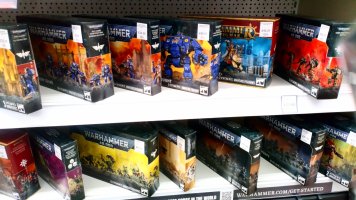
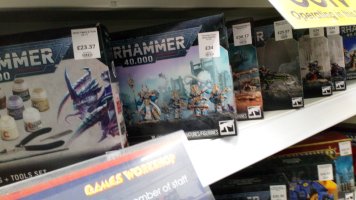
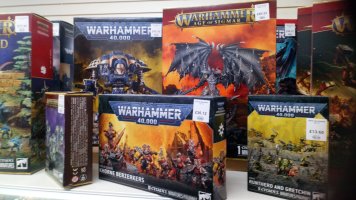
Now, I just feel GW is beyond unaffordable to it's younger customer base. It hit home a few years back when my eldest went to a Warhammer store with his mates for an open play day. One of his friends was shop 'pressured!' into buying the Necron codex at £25 a pop (wh40k 8th edition, so a good few years ago). It's the fact that ruleset must have all the add ons/ codices to play, before you've even started buying miniatures. Over priced. Anyhow I was in our local Boyes store the otherday. Pics as an example, and these are below the RRP, much much cheaper than the local Warhammer store. Bearing in mind the UK national wage is £8/hr for under 18s (even if they are lucky enough to get a p/t job in this economic climate!). These sets don't seem to affordable at even at knock down prices. Not affordable by any stretch if you've got to buy a few to get a game going. Yes, maybe, if they've had a whack of birthday money., but you ain't going to spaff it all. The smallest kit is the Runtherd + Gretchins at £13.60, an under 18yo would still need to work a couple hours for that! Sorry for shite photos!
 

Attachments

  • 40K stuff.JPG
    40K stuff.JPG
    1.3 MB · Views: 3
  • boyes stuff.JPG
    boyes stuff.JPG
    1.5 MB · Views: 3
  • Gretchins.JPG
    Gretchins.JPG
    2.1 MB · Views: 3
“unwashed maladjusted types” tend to be attracted to niche/nerd hobby cultures. I think I could possibly have been categorised as such when I was younger… Fortunately people can change and perhaps we should be less inclined to dismiss socially awkward people is such dismissive terms?
 
Back
Top