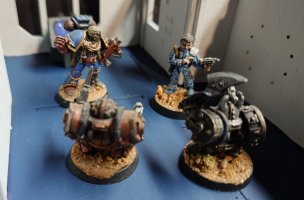
The Sentinel Gate Affair

The pictures seem bigger on the forum as opposed to the Tarterous Rim site, but I will add praise here as well, just a fantastic way to display opposing factions. Truly great stuff!
 
^They probably are bigger. I usually post versions hosted on Flickr scaled to 1024x768 on here. I post them "extra large" on Blogger, but it probably scales them down slightly more, since they're hosted natively on Google. Maybe I'll go and see if I can change the size some. (The originals are quite a lot larger still.)

Anyway, thank you!
 
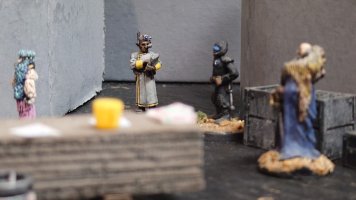
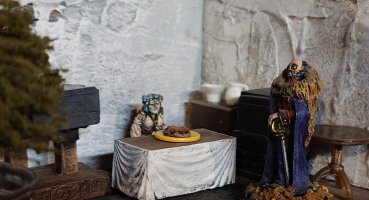
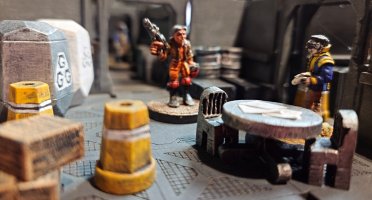
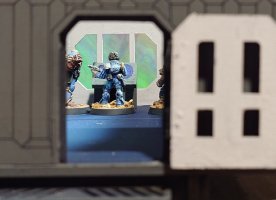
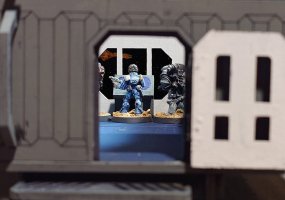
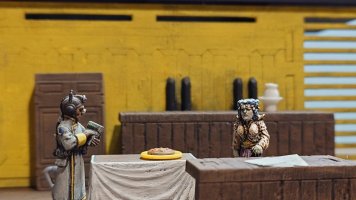
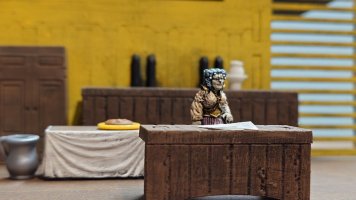
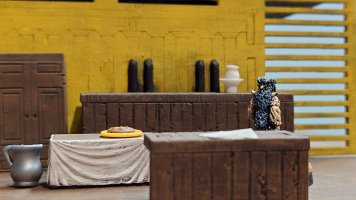
Colorado fought to catch her breath as she walked up to the long table. Deep in the bowels of the executive mansion the room looked to be a hastily converted storeroom, dusty from disuse and still packed with crates and boxes that hadn't yet been moved aside. Several of her friends and co-conspirators had already arrived. Christos Commodus, Lord Whye, stood at the head of the table, immediately to her left, a small pile of papers in front of him. To her right his eminence Yaddish, the Padda ambassador, stood with the elaborate pot of office that contained a quantity of the liquid his people used to seal agreements and to season nearly everything they ate. (Their word for contract, deelsous, apparently translated to agreement juice, though she suspected he had it tonight more for savory reasons than seditious ones. The rebellion was already thoroughly agreed to.) To his right were Dame Astrid Shaam, the Propraetor Jus Tartarum, holding her charge, Lord Ali Khan XIV. Over her shoulder her husband Lord Bakker Shaam, the fourth Baron of Morgan, glowered. Perhaps he was worried he'd lose his place in the cursus. They all would, at the very least. More likely they'd be burned as heretics, but there was nothing else to it. Behind them all Inspector Nguyen took notes.

WP_20220707_03_28_18_Pro-0.jpg


"Let's begin," Christos said. "Time is short, so I'll be brief. You should each have a handout, and there's a map in the center of the table should you wish to consult it. The matter at hand is securing the aid of the Tahti and Burgkhan Kaldun. They've been reliable friends in the past, but we're going to need all the aid they can give when the cruisers start dropping out of warp."
"Do you have an idea of the Terran commitments?" asked Bakker.
"Not yet, but they'll doubtless be significant. Colorado, do you think Sir Stanley could meet with the Dwarves? He seems to have a knack for it."
"I think it's their mutual fondness for a good malt," Colorado replied. "Yes, I think he'd be willing. He's with the fleet at Hecate aboard Proserpine. Could she be spared for the journey?"
Commodus scratched his chin and thought a moment. "Yes, I think so. It'd be a good exercise for them anyway." He paused before turning to the Padda. "Ambassador Yaddish, do you think you could make our situation clear to the Tahti?"
The giant frog croaked slightly, deep in his throat, before answering. "Yes, I think I could. But my shuttle couldn't make the journey. I believe they're presently out in the void past the Moirai."
"We could make Moab available for you. Would she be suitable?" Christos responded.
"Yes, I believe she would," said Yaddish. "That will be perfect."
"I believe that's the crux of the matter. We need to begin mobilizing and preparing as quickly as possible. Astride, I'm counting on you to secure support in the Senate and the Camarata. The Propraetor Imperium can be a bit headstrong, but I think you can get him on board. And with him the rest of the legislature should follow."
"And if not," she said, "I'll arrest him."
"My word, what days we've come to, when judges might arrest senators." Commodus shook his head sadly. "The only way to get the world we want is to fight for the one we're given. I think that covers everything. Carry on and let's make the inquisition rue the day they set foot in our sector."
A general round of assent went up. "Hear hear!" "Indeed!" "Amen!" and something guttural and almost primal seeming from the amphibiod throat of the ambassador.

. . . . . . .

WP_20220706_01_54_58_Pro%5BTRNRendevousWithBKN%5D-1.jpg


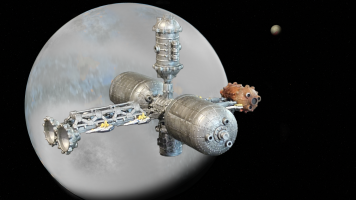
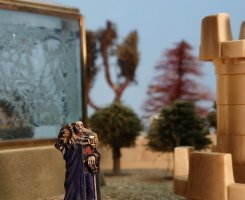
Sir Stanley Ursaline Drakemore stepped from his shuttle into the airlock of the BKN Chinghis Khagan. She was a truly massive ship, even bigger than Proserpine, quite probably the largest warship he had ever seen. He was surprised he'd been permitted to travel her corridors alone, but the bosun had given him clear instruction on where to go. He walked down the long hatchway to his right toward the blue door.

WP_20220707_02_34_41_Pro-1.jpg


WP_20220707_02_39_33_Pro-1.jpg


And passing through he found the freehold's Archmechan Timochi.

WP_20220707_02_50_33_Pro-1.jpg


"Your grace, Tartarus calls for aid. We have need of your assistance to protect the spacelanes from the Terran despot," he said.
In a deeply sonorous voice the armored warrior priest replied "The dwarves of Burkhan Kaldun Freehold are ever loyal. And we know the evils Terra would perpetuate in their constant fear of the other. We will answer your call. Say but where."
"That will be a matter for the admirals, but I expect they will make for the gate first. Either way, they'll need to pass Kerberos. And we've a good fleet base there."
"Then there shall we go."
"Excellent!"

WP_20220706_01_57_07_Pro%5BTRN-ElfRendevous%5D-1.jpg


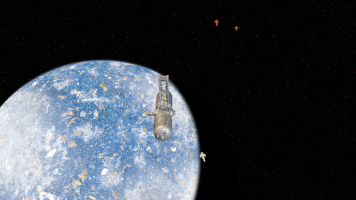
Meanwhile, in the far northern reaches of the rim, past the stars known as the Moirai, the froglike Padda ambassador made contact with a Tahti ship and thought about just what kind of "deelsous" he would strike that night to be sure of the elfin support.

WP_20210206_00_29_16_Pro%5BDwarfAndElfMass%5D-2.jpg


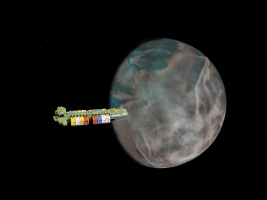
Barely a week later and fleets of the Tahti and Burgkhan Kaldun, the elves and dwarves as they were popularly known, were entering parking orbits at the sole planet of the star called Kerberos, just coreward of the Tartarus Gate, at the edge of the rim and sitting astride the only safe route from the Memphian sector.

. . . . . . .

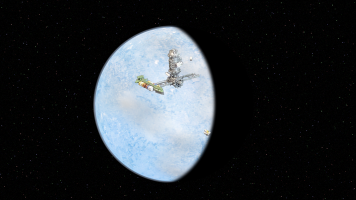
Further south, toward the galactic core, Augustus beamed as he arrived at Neith II. The ships of the Emperor's navy had begun to rendezvous in orbit beyond the moon even before he arrived aboard Armentarius.

WP_20220708_10_54_02_Pro%5BImpieFleet%5D.jpg


He boarded a pinnance and transferred to HIMS Legatus, which was acting as the flagship of the force.

WP_20220708_11_31_49_Pro-1.jpg


He met his brother inquisitor, Robert Gaihomme, at the first junction.

WP_20220708_11_35_12_Pro-1.jpg


"Augustus, you were expected. May your arrival bring us many blessings."
"And you also, Robert," Augustus replied. "This fleet couldn't arrive too quickly, though I surely wish it were larger. What can you tell me of our forces?"
"You've probably already seen all the ships. We've been dispatched with a half dozen galleons and half again as many galiots. We've a company of the sixth legions's finest aboard the galiots Aspis, Fulvius, Crotalus, and Ophiophagus."
"Excellent!" said Augustus. "The sixth is a suitably ardent legion. They've no love of mutants and xenos in their ranks. We'll need that kind of dedication to cleanse this sector of heresy." He thought for a moment before continuing. "I presume that you'll accompany the fleet, correct?"
Gaihomme answered "Correct."
"And has any thought been given to spiritual support for the legions?"
Gaihomme gestured to his left down the adjoining corridor. "Inquisitor Marcos Castrian will accompany them," he said, as a third grey armoured warrior monk strode into view.

WP_20220708_11_43_45_Pro-1.jpg


"Father Augustus," he said. "I'm honored to meet you. I've heard great things about your ardor in the Terran cause; your zeal to find and remove heresy. I hear you've found a den of it," he said grinning.
Augustus frowned. "Indeed Marcos. The Tartarans have taken to consorting with . . . elves. And orcs! I think I might have seen a floater. There were mutants beyond counting. There might have been ape people, the benighted frogs. It's beyond comprehension, I tell you."
"We'll sort it out and put them to the fire as lead the people down this path," Marcos said. "Don't you worry. "The Emperor's wolves will break their bones and rend their flesh ere another fortnight has passed."
"I pray you are correct," Augustus said quietly. "Organize your troops. You will take this rather modest armada and subdue Kerberos first, so that we can use it as a forward outpost from which to launch our attack into the heart of the Rim itself. May the Holy Terra's peace guard you and may you bring His Majesty swift victory."
Augustus took a step back. "I can't stay over long. I'll need to inspect our facilities on the surface to insure that the corruption hasn't spread this far. On the way out I sent word to a detachment of the 32nd Marines. They should be on planet now. I'll meet them. Send word after you secure Kerberos and I'll provide further instructions."
"Yes father!" the two monks said in unison.
Augustus strode off, re-boarded his pinnance, and soon found himself back in the comfort of a roughly Terran gravity well. This would be a long and complicated process, but in the end, he rather relished the task. He'd never before encountered such heathens in need of the Emperor's justice.

. . . . . . .

More should be coming along shortly, as the battle is already fought, I just need to get some photographs processed, and maybe a few more shots taken for storytelling purposes. But if you want some encyclopedic stuff, there's three entries of Jayne's Fighting Ships dealing with what you might encounter.

WP_20201210_19_11_45_Rich%5BSpaceGalleys%5D.jpg

Part I: The Imperial Fleet

WP_20210206_00_36_30_Pro%5BTRFleet%5D.jpg

Part II: The Tartarus Rim Navy

WP_20210206_00_33_35_Pro-1%5BBulkFreighter%5D.jpg

and Part III: Abhuman, Xeno, and Merchant Ships
 
^Thank you Padre! And on that note . . . more!

The Sentinel Gate Affair, Episode VI: The Battle of Kerberos

Gaihomme felt reassured when the fleet dropped out of warpspace and back into the comfortable reality of stars and moons, planets and people. The protector's ships surrounded him like an invulnerable cloak, stronger by far than his hard armor. He heard the chiming of several alarms and turned toward Captain Mickelson, listening as he called out to his crew.
"Hard to port and give me half thrust forward. The rebels are there at Kerberos, just as we expected."

WP_20220706_12_13_35_Pro%5BIMPAttackFormation%5D-1.jpg


Gaihomme glanced at the flimsy in his hand again:

Received 40.22.07.02 AIC
From Imperial Naval High Command, Terra
To the Lord Admiral of Imperial Armada 2406

Begin Transmission

You are instructed to escort the third company of 6th Marines to the Kerberos system, where they will commence with an assault on the orbital and ground military spaceport facilities of the planet pursuant to seizing same as a forward operating base for operation Justice Hailstorm. The company is to be embarked on four Serpens class galiots: Aspis, Fulvius, Crotalus, and Ophiophagus. For escort you will have six additional Serpens class galiots: Piscivorus, Contortrix, Polyepis, Oxyuranus, Bungarus, and Naja, two Comitatus class galleons: Dirk and Sacrificium, and four Furious class great galleons: Collegium, Magistratus, Legatus, and Praetor.

Kerberos is believed to be a significant operating base for the so-called Tartarus Rim Navy. As such, it is expected that you will encounter combatant warpships. You are ordered to engage and destroy any foreign military vessels you encounter. All are assumed to be either in open rebellion against the Terran Imperium or aiding such rebellion. You are further ordered to secure the nearspace areas in the system and to eliminate any such facilities as you find it necessary to ensure Imperial victory during the assault. In the event that you encounter an armada exceeding your own you are instructed to transit west towards Fort des Chartres if able. If you are unable to do either of these you are to fall back to the Memphian Sector and await reinforcements.

See attached catalog of assets, order forms, and star charts.

Endtrans


WP_20220706_12_13_57_Pro%5BImpBridgeComposite%5D-1.jpg


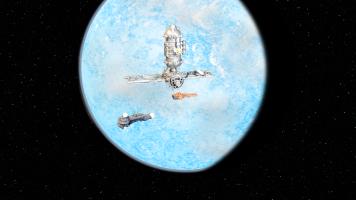
Gaihomme glanced out the bridge window. Kerberos loomed giant before them, two of the three moons barely visible above it. Coming away from it at great speed were a few poncy ships and a half dozen stunties, one a massive galleon larger than any he had personally seen. But the Tartarus Rim's provincial ships were not visible. His own armada, six galleons and ten galiots strong, should more than suffice to deal with the issue. He eagerly awaited what would be yet another glorious victory for the forces of Holy Terra.
"Action stations, everyone," said Mickelson casually. Almost immediately the klaxon began to sound and able spacers ran around the ship closing hatches and donning helmets.

WP_20220713_12_26_19_Pro-1.jpg


. . . . . . .

WP_20220714_03_10_49_Pro%5BBKNBridgeComposite%5D-2.jpg


On the opposite side of the field Sir Stanley looked out nervously from the Burkhan Kaldun flagship's bridge. In command, and seated in the captain's chair, was Progenitor Lucas Warmbier.
"What do you make of our chances, Lucas?" he asked.
"Mm? Oh, excellent, I'd say. The Impies won't know what hit 'em," Warmbier replied with an almost casual lilt to his voice.
Sir Stanley was a little surprised at his certainty. "How do you figure?"
"Well, we checked them out in a joint exercise on Thalia a while back. We've been doing quite a lot of that lately, just to check our records and update anything that's gotten out of date." At that Lucas paused a moment.
He took a pull on his pipe and continued. "It seems they've stagnated pretty badly back on mother earth, as they've gotten more religious about all this nonsense. They seem to have decided a ship should be handled a certain way, or a suit of armor. They think it's their god's word, or maybe a declaration from the Emperor. One or the other. Not that they necessarily recognize a difference there, what with their inquisitors and priests and warrior monks and so on."
Stanley nodded along at that. "I hope you're right. You're confident we can hold out until the TRN arrives?"
"My boy, we don't even need them. It'll be quicker and less bloody with them, so I'm glad they're coming, but trust me, we can take this bunch all by ourselves. They'd be hard pressed to beat even just the Tahti if we were still off at Burkhan Kaldun."
At that Sir Stanley was genuinely surprised. The Tahti force numbered only four ships. They were capable, but . . . four against sixteen? My word! Warmbier really was confident.
"Ensign, sound general quarters," said Warmbier, standing and turning to Sir Stanley. "I think it's time we donned our vac-suits Stanley. When this all over and we can breathe again properly I'll share a pint with you.
Stanley nodded and walked to the locker in Warmbier's day cabin as the bosun piped and the horn began to sound. That was an order he could agree with. "Nothing like a cold pint with Warmbier!" he chuckled to himself.

. . . . . . .

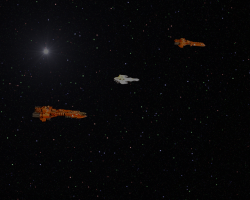
For a time, the two fleets closed on each other silently. And then, just as the dwarves and elves were almost within firing range of the Terrans a Tartarus Rim force dropped out of warp and began closing quickly.
"Blast! That will complicate things," Gaihomme cursed.
"We're picking up two to four galleons and a number of escorts," piped up a junior officer buried behind a viewscreen of some kind.
"That does away with our advantage in numbers. Maybe even puts us on the back foot," Gaihomme observed.
"We should be able to beat them with quality if quantity won't suffice," Captain Mickelson said. "A bunch of untrained provincials and conscripts. Probably half of them are criminals serving out their time."
Just then the shields began to flare, even before Mickelson gave the order to fire.
"Why on earth aren't we firing yet when they are?" Gaihomme demanded.
"They're not in range! How on earth can they target us this far out?"
A few seconds later Mickelson gave the order to return fire, but the damage was done. The bridge was in a state of silent shock, only broken when the great galleon off their starboard bow began to vent explosively into space.

WP_20220703_15_26_21_Pro%5B1stBattleOfKerberos%5D-3.jpg


"We've lost Collegium sir! And we're picking up a host of small contacts. It looks like they have fighters. Coming from the largest Tartarus galleon, a pair of smaller galleons on our right, and several small escorts on the left."
"Escorts?" Mickelson asked incredulously.
"Yes sir. And closing fast. They have at least 9TG acceleration."
"Sustained?"
"Yes sir."
"How would the pilots survive . . . "
He didn't have time to finish the question, as the "fighters" began exploding around them. Legatus was one of the first ships to lose power as the hail of splinters began cutting through cable trunks and spacers alike.

WP_20220705_15_18_33_Pro-37mos%5B1stBattleOfKerberos%5D-1.jpg


"Abandon ship!" the captain screamed, before leaping from his chair and dashing down the hatchway to the nearest boat bay. Gaihomme and the poor ensign who'd been calling out all the dreadful news followed quickly after.

WP_20220713_14_13_45_Pro-1.jpg


No sooner had the ensign cleared the hatchway from the bridge than it disappeared into a wall of plasma, venting from some broken line or other. Explosions rocked the ship. They might say that it was cold and silent in space, but war remained a hot and noisy affair, even if your screams would never reach enemy ears. He sincerely hoped brother Castrian fared better.

WP_20220713_14_33_02_Pro-1.jpg


It was a false hope. Aspis was struck in the same hail of missiles that finished Legatus.

WP_20220713_14_46_16_Pro-1.jpg


Even though Castrian himself escaped, nearly a third of her crew and passengers were consumed by the flames and splinters radiating out from a dozen explosions, both from the missiles and from Aspis tearing herself apart. Of the great armada, only three galiots returned: Piscivorus, Bungarus, and Naja. Of the third company of the famed Sixth Marines, none could seek the solitude of their fortress monastery. Castrian himself, and the bulk of his compatriots, were eventually rescued, even if it was only to be questioned by the lords of Tartarus and sent to await their eventual fait on Erebus.

WP_20220713_14_54_44_Pro-1.jpg


. . . . . . .

Behind the Curtain

This was, of course, a game. Several of my friends have been so kind as to run the factions, and several more willing victims helped to push miniatures around for the battle. Much has been left to chance. The resources of the Terran Imperium are vast, but her commitments are many, so luck plays the part of the fickle lords doling out warships in penny packets. Though you are permitted to count the cards battle is always a gamble. Even the best laid plans must face Dame Fortuna. The Tartarans are better prepared, but there is always wind and weather, even in space. And you just never quite know what the other player will do.
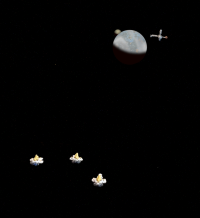
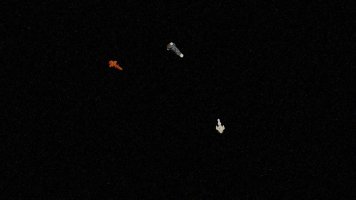
The first bit of luck was when the Tartarans arrived. They'd started four sectors away from the zone of engagement, but the Imperial fleet was sighted two sectors away, and the Tartarans know the territory and fly fast, so they were able to cover the ground in approximately the same time. The Terrans arrived first, but only by d6 turns. The . . . let's call it the Rim Alliance . .. since they were defending they started at the line of the planet. The Terrans were entering from the galactic south (or coreward in this case), which is to the right on the board. The defenders placed first and the Terrans placed in response to that. As a result, the allies decided to reshuffle their force on the fly. The rules of the game were a lightly modified version of Full Thrust. The usual order of things is writing commands for your ships and then moving according to them. Once everyone has moved, the fun begins. Fire is considered simultaneous, but for ease of play you fire in alternation, with the larger fleet going first. Damage doesn't really occur until after everyone has fired, but I didn't ask players to declare targets in advance or anything quite that fancy. At the end of a turn damaged ships might attempt repair. (And if they've dwarves aboard they might be pretty good at it.) The first turn, which you see below, was pretty quiet. Nobody had the range to shoot.

Turn1.jpg


As it happens, the Tartarans rolled a one on that d6, so they arrived on the second turn. And they were allowed to move as quickly as they wanted, so they absolutely booked. (And then immediately hit the brakes.) The Imperials simply marched forward steadily. And after all the moving was done . . . things were in engagement range.

Turn2.jpg


The allies basically concentrated their fire on the leading Terran battleships (or great galleons). After the first one exploded the elves switched targets to a destroyer, but there weren't too many guns left so it survived the exchange. The Terrans were still at pretty extreme range for their weapons and they were unable to do much.

Turn2Fire.jpg


On turn three things got more . . . interesting. The allies launched . . . let's call them "contacts." The rule of thumb here is you plot your orders, but before moving you move these "contacts" quite quickly and according to specific rules, which movement you see below.

Turn3MissileFire.jpg


Once that's done you move your ships according to their orders.

Turn3Movement.jpg


After that's complete the "contacts" do their thing, which is attack. At this point they're NPCs (non-player contacts), attacking whatever target in front of them is closest. Which if you play your cards right is the other guy. And oh, but it was.

Turn3Result.jpg


One battleship miraculously survived the onslaught, but two battleships, a cruiser, and four destroyers did not. And since this happens BEFORE the firing phase, those ships don't even get to shoot back. (They can and did engage the contacts, but . . . not effectively.) With the target selection greatly reduced the allies concentrated fire on what was left, thus eliminating the last two battleships, the cruiser, and another destroyer. The Terrans returned fire, of course, but at this point they were horribly outnumbered, so it wasn't very effective.

Turn3ShipFire.jpg


Quite reasonably, the Terrans attempted to retreat to the relative safety of warp space. The three destroyers on their left were able to break away. (They're surprisingly fast little snakies.) But the other two were surrounded and quite thoroughly cut off. They did their best, but there was nothing left to it but to be forcibly ventilated directly to space.

Turn4.jpg


The three snakes as made it off the table took word back to Inquisitor Augustus, but the rest of the Terran fleet became scrap for the Tartarans to collect. And their occupants, if not in pieces, will find themselves interrogated and shipped off to a POW camp.(It could be worse. I doubt the Terran zealots would be so friendly.) And I, your humble game-master, have rolled up the results, who was killed and who captured. What can be salvaged, and so on. The Imperium will doubtless send more ships. Likely many more after this debacle. We shall see where the fighting leads us next.
 

⏲ Please note there was roughly a 3¼ year gap between these posts ...

Time for a little thread resuscitation:

The Sentinel Gate Affair, Episode VII: Memphis Blues

Colorado inhaled the reek of sweat and sadness that had settled about her bed. For nearly everyone else in Logansport that day had brought victory and celebration. The battle at Kerberos had been brilliant beyond the fledgling Republic’s dreams. The Terrans had walked in, expecting everything to be easy. Only a small mixed force of Burkhan Kaldun and Tahti ships had been in system to intercept them, which might just have been enough, though the arrogant High Lords back in their ancestral warrens probably wouldn’t haven’t credited it. They couldn’t have known a much more substantial Tartaran force was already inbound, weaving through the surreality of transit space, making the odds overwhelming.
But the dwarves and their elfin allies had needed to hold the line at least long enough to prevent the Terrans slipping away before the hammer fell. And Lucas and Sir Stanley had been aboard the BKN flagship, Chinghis Khagan. She was the biggest target, so all the wrath of the Imperial Fleet fell on her massive bulk. It hadn’t even slowed the monstrous dreadnought. But one shot, one stray shot, had crippled Colorado’s heart, mortally wounding her.
The casualties had been fairly light on the Tartaran side. On the Terran side they’d been nearly complete; within a hairsbreadth of the total annihilation. All their cruisers. Every filigreed battleship. Their entire landing force. Nearly all even of their escorts, with only three escaping back to Memphis to tell the tale. The HQ had been abuzz with incoming dispatches, couriers running with flimsies still warm from their printers, waveless sets chattering, clerks shouting and typing with glee. Until a single somber one, Inspector Nguyen, walked over to her; his expression grim and solemn in the midst of the celebration.

20250728_104650-0 (Medium).JPG

“You might want to sit,” he’d said.
He didn’t even need to continue. She collapsed onto the nearest bench in utter disbelief. Somehow, Colorado already knew what he would say: in the midst of a victory he’d worked so hard to engineer, Sir Stanley had been deprived of its vision, leaving Colorado bereft of any joy in it.
Odd to take pleasure in so much death and destruction anyway. Surely the Terrans who had died had families too; lovers and children, mothers, fathers, friends who had enjoyed their warm smiles. Even zealots might be missed, she thought. Even xenophobes could feel pain; could suffer. She wanted to hate them, to feel nothing but bitterness towards them, to joy in their demise, especially now that they had ripped away half her own soul; her right hand and her faithful companion.
But she couldn’t quite do it. And so she lay in her bed that day and most of the next, feeling dark and storm tossed.
A quiet knock intruded, stirring her slightly before a head poked past the doorpost.
“Colorado, there’s news from the front,” said the deep, musical voice of Christos Commodus, the Tartaran proconsul. Former proconsul, she corrected herself. She wasn’t quite sure what he’d be now that they were in open rebellion against Terra. A heretic, probably.
“Can it wait?” she said.
“Probably best if it doesn’t,” he replied. “No need to be fancified, but take a moment to compose yourself and I’ll have tea and cakes brought. You’ll feel better for it.”
“Can you manage coffee?” she said.
“For you.”
“All right, give me a moment,” she said.
He turned and quietly closed the door. Colorado rose and pulled a bathrobe off a chair back, but cast it aside in favor of the rumpled clothes she’d worn when she heard the news. She buttoned the top tightly, hoping it would choke off some of the pain, and stepped out.
“All right, what is it,” she said.
“Lucas has decided to give chase. He’s hoping he can intercept the stragglers before they can carry word back to Terra,” said Christos.
“Does he hope to preserve some element of surprise?” she asked.
“Maybe. He thinks he can head them off in the Memphian Sector. And unless their Waveless network is a lot better than we’d guess maybe we can limit the damage and forestall all-out war a little longer.”
That cheered her up a bit.
“Wasn’t there an old Earth story about lost legions in the Black Forest in the ancient pre-Imperial days?”
“There was. A situation not completely dissimilar from our own. Word never made it back to the Emperor of one of their larger states; a Roman named Augustus. And he had enough troubles elsewhere he didn’t pursue the matter further, leaving the sweaty leather-bound barbarians to fend for themselves a while longer.”
“I’m not that sweaty,” she said.
Christos gave a sniff. “Yes, you are Colorado. You need a bath and a meal.” There was a knock at the door. “Sit. That’ll be the meal.”
A page sat a steaming tray down on a small table with two chairs in her sitting room. The proconsul waved him off with a nod and then pulled out the chairs himself. Colorado took the one nearer her bed chamber door. Christos poured her a cup of coffee and then took the other.

20251020_150728-1 (Medium).JPG

“Has he set off then?” she said.
“Probably. He indicated that it was his aim to leave immediately, taking only the time to refuel, and reload.”
Colorado sipped gingerly. Her mouth was dry and unpleasant to her taste. The coffee would have been better if she’d taken the time to freshen up first, but maybe it would still give her the energy to face the terrible days ahead.
“What’s the next step?” she asked.
“I’ll need a new Secretary of War,” he said. “Do you think you would be up to the task? You knew Sir Stanley’s plans better than perhaps anyone else; better even than I, I think.”
“Will the Diet approve?” she said. “I’ve never been a senator.”
“You’re already a Councilor,” Christos replied. “I don’t think it will be a problem. I’ll make an interim appointment and put the nomination before the full Diet as soon as I’m back on Proserpine.” He paused, then added "It'll be easier now that Astride has brought Propraetor Angeline on board."
Colorado sipped her coffee and ate a bit of the cake. "I was terrified she'd try to hand us over."
"Her interests are too tied to the Rim. She's no fan of mine, but she's not going to accept Terran hegemony any more than you are," Christos said.
They ate in silence for a few more minutes. Colorado rose first.
"Thank you Chris," she said.
"You're become quite dear to me, and you've lost a lot," he said. "It's the least I can do."
"Just the same," she said and stopped. "Thank you," she added, walking out the door."

. . . . .

Warmbier briefed the officers under his command in a voice grown hoarse from barking out orders over radios and waveless alike. There'd been damaged ships to send to dockyards, munitions to allocate and order. Fuel tenders needed tanking and cruisers didn't run on liquified deuterium alone. Nothing ever seemed quite done. But the men around him were to be the ferrets chasing the rat into it's tunnel lest a swarm of them come pouring out and tearing the fragile peace to shreds. What irony that such a new alliance would drag them into an existential war. But dame fortune always seemed to enjoy a farce.
The squadrons were scheduled to depart before daybreak, barely more than a day after Kerberos. Most ships were still taking on missiles from the precious local stock, but a few could be spared that used more conventional beam weapons. For the escorts that had escaped the battle that should suffice. Admiral Bobson of the Tartarus Navy and Admiral Telvanni of Warmbier's own Burgkhan Kaldun service would each command detachments. Warmbier himself was aboard the cruiser BKN Jaruud.
A short time later, aboard his new flagship, Warmbier listened to the familiar rhythms of a ship casting off into deep space. The bridge watch discussed navigation and reported transit conditions. Sensor techs in the CIC immediately aft of the command bridge warmed up their sets, concentrating first on passive arrays and waiting to test active arrays until they were a little distance from the station. Warmbier gazed fondly at the massive domes on Lachesis visible to port out the bridge windows. Those would come in handy.

20251030_160629-3 (Medium).png

The chatter grew more formal, orders fewer, but quicker and crisper. They cast off their moorings and reaction thrusters carried them gently away from the docks. The main drive thrusters kicked in shortly after with a subtle hum that pulsed through the ship, pushing them towards the invisible point where they could warp into transit space. A klaxon buzzed as the transfer unit engaged and pulled the cruiser through the seams of spacetime into transit.

20251030_160629-2 (Medium).png

To experienced spacers and grizzled veterans like Warmbier the shifting lights of transit space came almost as a welcome embrace. The chase was on.

. . . . .

20251114_130329-1 (Medium).png

Aboard Piscivorus Lieutenant Commander Markus wept at the sight of Barankus Station. The transit from Kerberos had been even more terrifying than usual. Tendrils of unreality stretched from horizon to hull, from nowhere to everywhere. Each could conceal a heretic as warped as the strange transit dimension itself. At any moment they might mutate into beams of energized particles to begin boiling away his viewscreen into streams of plasma. Seeing the station, glittering in realspace when they warped back out meant he'd be able to sleep at least one more night behind fortified walls; that he'd have one more day, one more opportunity to carry news of the xenophiles home.
Someone had to inform His Sublime Majesty, the Emperor of Terra and all Space, the Defender of Humankind; that the Tartarans had some kind of dark sorcery. He had to learn that they had vaporized great galleons in moments; that they had autonomous kamikaze drones, probably from the cursed Tahti; energy beams of the greatest range and capacity apparently mounted in ordinary batteries; that their ships were fast and well built, and worst of all, piloted with skill. He would do it. He would carry the word.
Incoming transmissions made it clear Inquisitor Augustus had come forward to Memphis awaiting word of the battle. Markus would tell him all that and more, carrying him to the safety of Holy Terra.

20251114_131000-1 (Medium).png

Piscivorus docked and Augustus came aboard. Markus met him at the gangway and showed him to the captain's mess where the two could talk privately.
"You were meant to return victorious. I gather from your numbers and the initial reports this is not the case. Why so few?" he said.
"It was a trap, father," replied Markus. "We never had a chance."
At that Markus related the tale of Kerberos, of the many headed guardian at the gate devouring the souls not of the sinners, but of the faithful.
"Is there no word of Gaihomme or Castrian?" Augustus asked.
"None, father," he said. "Legatus was disabled fairly early, and she was in the center. There was a lot of radio interference from mcironukes exploding everywhere."
"Micronukes?"
"The enemy appear to have suicide drones that track a ship and explode when they get close enough. Our energy shields couldn't handle that kind of punishment. They're optimized for the B class beam batteries everyone uses, so the drones just slipped past completely."
"So they have new weapons, surpassing us technically?" Augustus said dourly.
"Yes, father." Markus replied. And he related the rest of the battle in greater detail.
The two made plans late into the night as the little flotilla refueled. In the morning they went aboard the station and briefed the local Memphian forces. They left instructions for the station and the gigs. The former was to destroy the fuel rather than surrender it to the heretics, the better to slow their pursuit. The latter were to do whatever possible to protect themselves and their families from the greenies and poncies; the frogs, rats, and mutants who were hell-bent on enslaving humanity. Augustus admonished them that it was far better to meet death with honor than to fall prisoner to such corrupt and degenerate souls as had taken over their neighbors to rimward.
If there were a few skeptical glances from the back of the crowd Augustus didn't notice it. Markus watched as a few people left early. Not everyone looked completely enthusiastic about what was to come, but given what he'd seen he wouldn't rush to face it again either. These poor souls were stuck here with their families. For them there could be no flight. But Markus had to get Inquisitor Augustus back to earth to inform the Collegium. Somehow they had to spare enough from the Hexie front. After the victory Pomadorus had won maybe, just maybe they could. All too soon Markus and his brethren warped back out of Memphis, flying on the winds of luck and the scraps of a plan.

. . . . .

So behind the curtain, there are bigger versions of the pictures on the blog, but it's otherwise pretty much the same. And the blog doesn't have the bit that's coming next.

This is, of course, a campaign. (I'd always meant it to be one.) With players. Who are suffering from a bit of information asymmetry. None of this is balanced, but wars just aren't. I'm making no effort at all to make this any different. I am, however, trying to make it interesting. The Tartarus Rim has better tech and better intelligence, but a much smaller military and very limited supplies. The Terrans have a seemingly limitless array of cruisers they can simply hurl into the fight if they choose to. Though they do have some other commitments that might keep them up at night and make them think twice about sending their entire military to the edge of nowhere. I'm hoping to make this a little more regular. We're four turns in. There are maps. I'll put some of that in the next blog post. :) I've . . . failed . . . many times before. But I think some of the chaos of the last year is beginning to die down. And the players seem sufficiently engaged now to help me push it forward. Wish me luck.
 

⚠ Please note that until the post above this thread had been inactive for about 3¼ years ...

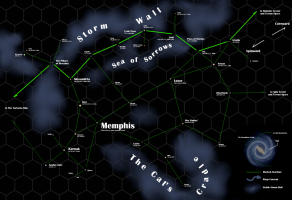
^Thank you! More is coming shortly. I plunked some campaign maps in the maps area, but here's a bit to make them more relevant. Does a battleground report count? Attached below is the first of two reports detailing the Memphian Sector and its peculiarities. Things are pretty simple as they stand right now, since it's just three Imperial destroyers (or galiots if you prefer the Terran terminology) fleeing from Kerberos. A force of several Tartaran ships began pursuit a day later, after quickly refueling and taking aboard the necessary supplies.

The most important consideration is fuel, though there are some local forces that could be recruited to either side. There's also some political considerations that might come into play when the Imperials return in force. (They surely will, it's really just a matter of how quickly, how strongly, and with what intelligence. There's just enough folks nearby who might be willing to play that I can probably recruit fresh victims if I really need someone to play who didn't see what happened in the previous battle, though for now everyone is familiar with it.)

I've worked out some basic fuel capacities, endurances, and cruising speeds for everyone. There's also the possibility of navigation errors. But the description contains a lot more than just the capacity of the tank farm at the local orbital gas station. There's also some hints about which systems might be strategically interesting, which might have the best lines of communication out of the sector, and maybe even where some local sympathies might lie.

The short hand version of game right now is that the three Imperials each have a safe endurance of three days, and they can move two KParsecs a day at normal cruise. (Or two hexes a turn, if you prefer.) They can push to three hexes if pressed, but it will cost two full turns worth of fuel. Refueling requires between a half turn and a turn, give or take, depending on local conditions. Beam weapons are ineffective in transit space, since it bends light in such weird ways, so battle there is less common, but you can absolutely track someone through transit and jump them as soon as they warp back into normal space. Better sensors have longer ranges and a higher likelihood of detecting ships. (It's never guaranteed. A a hex represents a full kiloparsec, after all, which is a whale of a lot of space.) But I figure popping in and out of transit space leaves a pretty clear signature, especially if you're in a hurry, rather like the screw noise of a passing ship on passive sonar. So right now it's a bit of a game of cat and mouse.

Anyway, what follows is my little brief to my players about the field, save with some added pictures for funsies. (Or the first half of it anyway. The better to give myself time to work up more pictures for the second half.)

. . . . .​

Jayne's Defense Weekly - A Physical and Economic Description of the Memphian Sector: Part One, the Heirtaic Province and the Dog Track

memphiansector-jpg.15635

Here at Jayne's we've been putting the offensive in the defense industry for generations. Jayne's isn't just about estimates of ship classes and fleet sizes, it's also about where to build them, refuel them, maintain them, and equip them. We've talked about the Hexie Wars in depth in the past. Given the recent instability, we bring you a series on the extreme galactic north; places like the Agfa Sector, the Memphian Sector, and the Tartarus Rim.


The Memphian sector is a remote segment in the Sagitarius Arm in the galactic north averaging more than 70,000 light years from Sol. To its interior lie the Halonite and Agfa Sectors. Beyond it is the Tartarus Rim. It isn’t an especially star dense or busy area, but there are two significant trade lanes that travel through it: the Dog Track traveling through the Hieratic Province, which is safer, but somewhat slower, and the Sickle traveling through the Mesostimonic Province, which is slightly shorter, but more susceptible to closure by transit space anomalies, since it lies between two regions of considerable instability: the Storm Wall and the Sea of Sorrows. At the north end of the Mesostimonic Province is a small, isolated region called the Helene Pocket.
The coreward boundary of the sector lies in two systems, Irkalla and Khartoum. Irkalla serves as the gateway to the Halonite Sector. From Khartoum it is possible to reach the Agfa Sector, which guards a spur star-bridge to the rich Scutum Minor Sector of the Centaurus Arm and its favorable route around the core to central Terran space. This fact alone makes the Dog Track the somewhat preferred route for merchant traffic to and from the core, since the Imperial Beacon is usually detectable from Scutum Minor, making navigation safer and easier and reducing reliance on freespace navigators.
The spinward boundary is marked by the Anubis Gate system and the Pillars of Hercules binary. Spacelanes from both lead to Vide Poche in the Tartarus Rim.

The Heiratic Province and the Dog Track
TheDogTrack.jpg
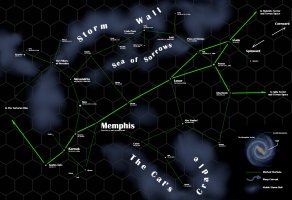
The Route known as the Dog Track is highlighted in bright green.

Anubis Gate

Anubis Gate is a blue giant with one distant gas giant. There is a small hydrogen mining and metastable metallic pressing operation and a small commercial station with limited refueling capabilities, sufficient for both chemically and fusion powered vessels, with total tankage capacity of around 30Ktons liquified deuterium (LD) and 40Ktons metastable metallic hydrogen (MMH) and a refining capacity of about 1K tons of each per day.

Karnak
Karnak is a red sub-giant with nine planets, and two in the habitable belt. The fourth planet, Henut, is the only planet with significant human settlement. It is a modest, rocky planet that was terraformed for human habitation during the first imperium. There is an administrative center with local government facilities, and it serves as a minor local trade center with routes serving Kadre, Djoser, and the binary Isis-Osiris system beyond, but the planet is otherwise primarily agricultural. There is a modest orbital port facility, with bunkerage of 40Ktons LD and 20Ktons MMH and civilian hull and drive systems repair and one repair bay with a length of two hundred meters and a capacity suitable for a ship of approximately 30Ktons.
The other habitable planet, Karnak III, is primarily aquatic with only one modest, low lying land mass that is frequently flooded. There is a Batrachian settlement here of some interest for study, but little commercial value. The other three rocky planets, Karnak I, II, and V, have little to no breathable atmosphere and only limited mineral value. There is some metal mining on the moons and in the rings of Karnak VII. Karnak VI is highly energetic, almost a dwarf star itself, it has no rings, and its moons are unsuitable for mining. Karnak VIII and IX are both modest ice giants of no known interest.

Amarna
The Amarna system is unremarkable system, save that is it s a G type star with only one small, rocky planet in the habitable belt that has been terraformed. The world is otherwise a fairly typical agricultural world. There is a small dock, with a modest fuel storage depot of perhaps 20Ktons total (all types), but there are no heavy repair facilities and there is no industry to support it.

Memphis
The Memphis system is the military and administrative capital of the sector. There are two major worlds in the sector and two stations of note. Memphis I, Confedaracion, is a lush and remarkably clement world with an ample temperate zone and several major cities. The world is largely self-sufficient, with ample agriculture and even modest industry. There are two orbital stations, the first is an330 Imperial dockyard called Barancas Station. The station has a barracks adequate for a legion or regiment and provisions to scale. Sufficient slips are available to simultaneously service four ships of approximately capital size and a dozen escorts, and there is bunkerage of 200Ktons each of LD and MMH. Additionally there is a civilian dockyard called Mud Island with 100Ktons of LD and 50Ktons of MMH. Mud Island is also in possession of a 300m repair bay, two 100m repair bays, and a pair of 50m mobile repair docks. The station has full civilian heavy repair facilities for handing any civilian drive, communication, reactor, screen, or environmental system.
Memphis II is a gas giant with several mineral rich moons and a substantial series of rings. There is a mining and refining operation with a capacity of around 2Ktons each of LD and MMH per day, though there the tankage is surprisingly modest, with a storage capacity of only 20Ktons each. The flow of in-system tankers is fairly constant.
The largest moon of Memphis II, Kroaker, is a tectonically active frozen water world with a breathable atmosphere. It gets its name from the unusual sound of its most famous geyser. While surprising, there is a small Batrachian colony there, living in habitation domes under the ice. They don’t venture off their world, but they are well equipped, possibly due to occasional trade with cultural tourists. They have been permitted to remain as there is nothing of any known value on the moon.
A fair volume of trade runs through the system as it lies on not only the Dog Track, but also the primary cross sector trade route, between Bastet and the Trojan Binary. At least one major merchant vessel passes through the system daily, sometimes more, and there’s generally one or two merchants at the Mud Island docks. In spite of the size of the military dock, most military vessels seen in the sector are auxiliaries moving materials or service personnel into or through the sector. There are no galleons or galliots home ported at the docks, but there is a usually gunbarque for local patrol and trade inspection and two or more gigs for system defense.
Memphis (Medium).png
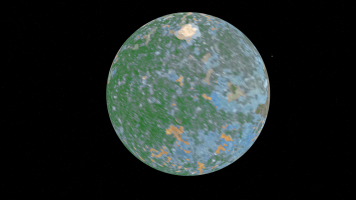
Confederacion on a rare cloudless day.

Faiyum

The Faiyum system centers on a red dwarf. There is only one small, rocky planet in the system. It serves as an occasional rest or fuel stop for merchant vessels, but is otherwise arid and unremarkable. There are a few small mines on the surface, and there is a quite small orbital station, but it is otherwise unremarkable. Tankage available is 10Ktons each of LD and MMH.

Luxor
Luxor is the rare G-type star possessed of but a single planet, but in this case the planet is not only habitable, but relatively temperate and fairly developed. There is a commercial station in orbit around the eponymous planet with a 200m repair bay and fuel storage capacities of 100Ktons LD and 50Ktons of MMH.
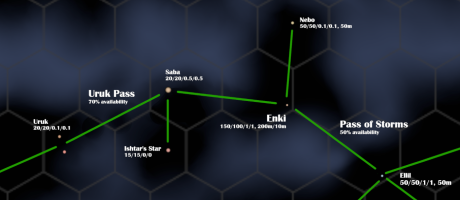
Past Luxor the Dog Track splits into two branches. The more heavily trafficked southern route leads to Aswan, beyond which the track splits again to either Khartoum, or Irkalla. The northern branch leads through Ellil, which gives access to both Irkalla and the Halonite Sector beyond, and the Pass of Storms leading to Enki and the Sickle.

Aswan
Aswan is a Class Ia luminous supergiant. It is quite unusual in having five planets. The innermost two are rocky planets with neither atmosphere nor satellites. Aswan III is a gas giant with four useful satellites, one of which, Amada, was terraformed long ago thanks to its generous frozen hydrosphere covering subsurface oceans of substantial volume. Between Aswan III and Aswan IVa there is a broad and mineral rich asteroid belt. Aswan IVa is an ice giant, tilted on its axis, likely by the same cataclysm which created the asteroid belt.
Aswan IVb is likely the source of that cataclysm. It lies on a very high eccentricity orbit that usually makes it the systems fifth planet, but which at periastron brings it briefly inside the orbit of Aswan IVa. It’s orbit, and mineral composition make it quite likely that this was a wandering planet captured by Aswan early in its life cycle. Aswan IVb is the single largest planet in the system, and its orbit carries it both above and briefly below the system’s primary plane. Its close interactions tend to cause meteor swarms on both Aswan IVa and Aswan III, which makes permanent habitation virtually impossible. Settlements on Amada are universally portable.
There is a modest orbital station that can be moved as necessary around Aswan III to shield it from the worst ravages of the meteor storms. It boasts only rudimentary ship servicing facilities. The single repair bay is sufficient only for light craft of 50m or less and fuel storage is quite modest, which only 10Ktons each of MMH and LD. The extraction plant produces around 1Kton per week.

Khartoum
After Memphis, Khartoum might be the richest system in the sector. It has six planets, one of which is inhabited, a small, but stable asteroid belt, and a good gas extraction network. It isn’t heavily industrialized, but it is rich enough in natural resources and its position is sufficiently strategic to make it a popular refueling stop.
The innermost planet is devoid of atmosphere or mineral interest. The second planet, Soba, is the most developed, having just enough water and a stable enough nitrogen atmosphere to allow terraforming. It’s a bit arid, and rather hotter than earth, but just habitable in the temperate zones, which have temperature variations comparable to earth’s larger deserts. The orbital station would probably be larger if there were a significant manufacturing base to support it, but even without heavy repair facilities it is nonetheless impressive. The station boasts a tankage of 200Ktons each of LD and MMH. There is also a substantial transloading facility, and microgravity warehousing and even an orbital university with a gas mining program and a small private dockyard supporting the school’s own mining ships. Further, there is a bustling orbital market where small merchants from not only the Memphian sector, but also adjoining sectors trade local wares for materials from coreward worlds.
Khartoum III is an unremarkable small rocky world without atmosphere. Khartoum IV has a thin nitrogen/methane atmosphere, but almost no water, and only one small, irregular moon. The asteroid belt lies between these two planets. There is a mining station on one of the larger bodies in the belt, along with a small customs station which hosts a small dock to support three system patrol cutters, but none of these cutters are capable of warp transition. Generally two are on patrol and one is in port at any given time.
Khartoum V and VI are both gas giants with substantial extraction operations, but little local tankage. The product is mostly shipped inward for storage by a fleet of small gas tenders.
20251124_112322-LinerAndRevenueCutterAtKhartoumII-Soba (Medium).png
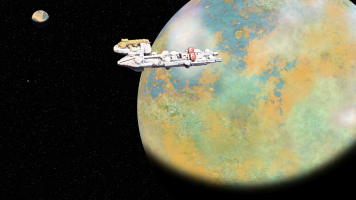
An Imperial Revenue Service Barque approaches and inspects a TRS liner entering orbit at Soba.

The Karnak Subsector

The Karnak Subsector incorporates five systems: Karnak and Anubis Gate have been previously described. The other three systems are Kadre, Djoser, and the Isis-Osiris binary.

Kadre
Kadre is a small, isolated system with two planets. Kadre Prime is a rocky world with a research station studying the effect of stars on warp field mechanics. Kadre Secundus is an ice giant. There is no orbital station in the system.

Djoser
Djoser has but a single planet, Saqarra. It was at one time a factory world, but now lies abandoned.
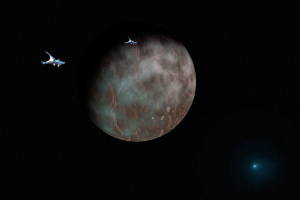
TahtiCruisersAtSaqra (Medium).png
A pair of unidentified Tahti galleons are seen orbiting the ghost world Saqrra in the Djoser system.

Isis

Isis is one of a pair of binary stars with one planet of its own. The planet was terraformed in the distant past, but the colony collapsed for unrecorded reasons. It is suspected that it might still support life, and there is currently consideration of re-colonization.

Osiris
Osiris is a dwarf star with four small, rocky planets. Osiris II, the only one with an atmosphere, is an extremely cold world with scant resources, but the presence of water makes it the subject of some speculation.

The Giza Independent System

Giza system constitutes an independent subsector all its own, since it lies between Memphis, Amarna, and Alexandria. The system primary is a bright giant, and the system includes seven planets and an asteroid field. The first two planets are modest dead planets, stripped of their atmospheres by the strong stellar winds. The asteroid field lies between these two and the fourth planet. It’s presence in Giza’s “goldilocks” zone is quite unusual, and has allowed several of the larger bodies in it to be colonized independently.
The largest, Cheophis, has a gravity of just .15G. This isn’t enough to allow it to retain an atmosphere of any appreciable density, but it is enough to make hydroponic farming in domed habitats quite simple, and so the three dwarf planets serve as unusually large and profitable, almost self-sustaining stations. Khafren and Menkaurum both have two stalks with space elevators to microgravity docks with tankage for 20Ktons MMH. Cheophis has five stalks, two provide tankage for 50Ktons each of MMH and LD, as well as three 50m slips capable of light and medium repair.
Giza III and IV are gas giants supplying the system’s needs. Giza V and VI and VIIa are ice giants. And Giza VIIb is a captured comet on a relatively stable orbit.

The Qarun Independent System

Qarun centers on a large brown dwarf. Orbiting the star are fully seven planets, though all but the closest two are frozen. No planet in the system has a breathable atmosphere, but the location of the system makes it a useful waypoint, and there are some useful minerals to be mined on the smaller bodies. The inner two planets are airless rocky worlds. Qarun III and IV are frozen rocky worlds with thin CO2 atmospheres. Quran V is an ice giant with several moons, once of which has subsurface water. Quran VI and VII are small, frozen worlds. The only permanent station orbits the water moon of Quran V. It has tankage for 20Ktons MMH and LD.

The Cairo Subsector
This subsector comprises Cairo, Mut, and Bastet. It can be accessed from Memphis or Abu Simbel, and it provides the sole entry into the stable space pocket in the storm system called the Cat’s Cradle.

Cairo
The administrative center of the subsector is Cairo, a system with five planets. The inner two planets are the airless rocks one expects in such a system. Cairo III is inhabited, but arid. The surface provides some mining and light industry. The orbital station has tankage for 50Ktons MMH and LD.
Cairo IV and V are ice giants with insufficient free hydrogen to make mining profitable, so fuel is mostly shipped in from Mut or Memphis.

Mut
Mut is a red sub-giant with five planets. The three inner, rocky planets are all too close to the star to be useful. The fourth planet is rather distant gas giant, so there is gas mining sufficient to support both a local station and fuel for Cairo and Bastet. There is an orbital station at the principal moon, which is rocky and mineral rich. The station has tankage for 40Ktons of MMH and LD. The fifth planet is a small and distant icy world.
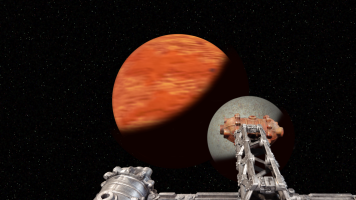
MutAndMoon (Medium).png
Mut IV as seen from the orbital station of it's principal moon Mut IV-C

Bastet

Bastet is a red dwarf with one rocky planet, Bubastis, on a relatively close orbit. While the atmosphere was probably dissipated in the stellar winds, it was later terraformed sufficient to give it both a breathable atmosphere and sufficient water. There is evidence that it was a substantial colony once, thousands of years ago, but the only remaining institution is a compound belonging to the Sisters of Bast. The orbital station has tankage for 10Ktons of MMH and LD.

The Abu Simbel Subsector

This subsector comprises two systems: Abu Simbel and Semna. There is a minor shipping lane that traverses the subsector and connects Khartoum to Memphis via Cairo.

Abu Simbel
Abu Simbel is a comparatively rich system, particularly for one whose primary is a red giant. The six worlds of Abu Simbel provide a wide variety of resources. The inner two planets are relatively rich in useful metals, if difficult to mine given their heat and proximity to the primary. Abu Simbel III hold some promise for terraforming. Its methane rich atmosphere is too thick and traps too much heat, but properly engineered microorganisms might be able to metabolize it into something more useful. Abu Simbel IV is a rich agricultural world with a modest transfer station and 40Ktons capacity of both MMH and LD. Abu Simbel V is a gas giant with extractable concentrations of various hydrogen isotopes and other useful gasses. Abu Simbel VI is an ice giant, but it has two mineral rich moons and a series of quite lovely rings.

Semna
Semna and its five planets comprise the final part of the Hieratic Province. The primary is a small K3 type star. Semna I is just distant enough, and the primary is just dim enough, to allow terraforming. The world is primarily agricultural and mostly self-sustaining. There is an orbital station with 30Ktons bunkerage of both MMH and LD. Semna II and III are both gas giants, but their composition is too low in useful isotopes to allow for any substantial mining interest. Their moons are simple silicates with no real mineral interest. Semna IV and V are both small, icy planets.

. . . . .​

In our next edition we'll bring you a description of the Mesostimonic Province and the Sickle. It is ever the hope of Jayne's that a fuller understanding of the complexities of the galactic situation will help to bring a more complete and lasting peace and a prosperous future for humanity. The galaxy is a large, and complicated place, but it is not beyond our ability to learn and understand it, and good intelligence is the first step in achieving a positive outcome in any complex situation.

 
This issue continues our series on the Memphian Sector. Recent events have brought this quiet region attention, since it borders the Tartarus Rim, from which rumors of war and rebellion are presently radiating. For a description of the Dog Track and the Heiratic Province see the previous issue.

The Sickle and the Mesostimonic Province


TheSickle (Medium).png

Irkalla
While Irkalla can be accessed via the Dog Track, it is also the southern terminus of the path known as the Sickle. It’s a small system, centering on a F0 type star with only two planets, both ice giants. The only permanent settlement is a modest transfer station in orbit of Irkalla II with a fuel storage capacity of 50Ktons each of MMH and LD. There are marked routes out of the system to Asmara, Aswan, Ellil, and the Halonite Sector.

Ellil
Ellil is a white dwarf with three planets. Ellil I is a small rocky planet with no atmosphere. The second planet, Nippur, is a large rocky planet. It is quite rich in rarer minerals, but atmosphere is quite thin and very cold, so habitation, industry, and commerce there are entirely underground. Ellil III is a gas giant with sufficient atmospheric hydrides to make gas mining profitable. It supplies about 1K ton each of MMH and LD daily, and the tanks at Nippur can store about 50Ktons of each. There is also a 50m repair slip.

Pass of Storms
The Pass of Storms serves as the southern or coreward gateway into a long, linear area of space bounded on both sides by areas of intense warp instability. To the east is the nearly impenetrable Storm Wall, a band of storms so intense that even the bravest navigators avoid it. To the west lies the Sea of Sorrows; an area steeped in space stories both heroic and tragic from the early days of its exploration right up to the present. Spacers do sometimes navigate this band, but transit are perilous, since navigation is inevitably slower and less efficient and the unpredictable currents have a habit of spitting ships back out in unexpected places, short of fuel and supplies, and breaking up formations, leaving their individual members widely separated and out of contact with one another.

Even the pass itself is tricky, since there are storms blocking it roughly half the time, though the lane markings make navigation somewhat easier, even in those circumstances, roughly halving the chance of significant course deviations.

Enki

20251217_012618-EverStoic (Medium).png
RS Ever Stoic approaches Dis in the Enki System. Nissiku is faintly visible to the upper left.

At the north end of the pass the route reaches Enki, a red dwarf with seven planets. While several of these planets were doubtless quite habitable in the distant past, the diminished output of the sun has left all of them, save the very closest, cold and inhospitable.

The first planet, Nissiku, is a typically small rocky planet. It was probably tidally locked and airless at one time, but terraforming in the distant past reintroduced a spin and to give it a breathable atmosphere, making it among the closest known inhabited planets to a system primary. It is the site of an important school teaching both astrogation and astro-engineering, as well as history, philosophy, and interstellar communications. The planet is not heavily populated, but this alone makes it important. Industry there isn’t especially heavy, but it is sufficient to support the school’s orbital laboratory. The orbital station has two slips. The smaller is only 10m, but the larger is 200m in length, making it one of the few stations in the system capable of heavy overhaul on large warships and midsize freighters. Tankage is 150Ktons MMH and 100Ktons LD.

The second planet, Nagbu, is largely ice covered, and probably supplied most of the water for terraforming Nissiku in the ancient past, but today it is uninhabited. The third planet, Dis, is also uninhabited, though it has ruins of archeological interest that might provide clues into the forgotten past of the system if funding is ever available for exploration.

Enki IV is a massive gas giant that provides a second source of heat and energy in the otherwise dim system. Not only is there a small gas mining operation, producing about 1Kton each of MMH and LD, but there are also two inhabited moons; Abzu and Eridu. The first is an ice moon with subsurface seas. There is a domed resort on its surface that is a popular stopover for local and long-distance passenger traffic. The second is home to a small religious site important to the peregrine Tahti.
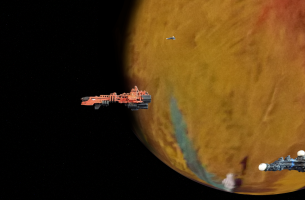
Enki V, VI, and VII are ice giants of no significance.

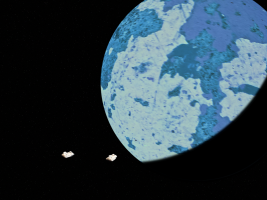
Saba
Saba is a bright red giant with six planets. Despite their number, the system isn’t terribly heavily developed. The innermost five planets are rocky worlds. None have any atmosphere, thanks to the strong stellar winds. Saba VI is a modest ringed gas giant with several moons that have been explored for minerals, but there are no permanent settlements on the surface of any of them. There is a small gas mining operation, able to extract several Ktons a week of MMH and LD; essentially enough to stock up a local fueling depot with 20Ktons capacity of each. There are a few mining depots in minor outer system bodies, and there are rumors that the Tahti establish camps there sometimes, but nothing has been confirmed.

Uruk Pass
While not nearly so treacherous as the its coreward cousin, Uruk Pass is nevertheless a difficult passage, being plagued by warp storms roughly one time in three.

Marduk
One of two stars in a binary system, Marduk has three planets; two rocky planets and one gas giant. None have permanent settlements. There are no known resources of any significant value, but there is a small emergency station used by beacon tenders and patrol vessels. The station has tankage for only 6Ktons of LD and 3Ktons of MMH, and no repair facilities.

Uruk
Unlike its companion star, Uruk has some appreciable development. Of the four planets, the second is a small rocky world called Warka with a breathable atmosphere, a temperate climate, and abundant water. There isn’t any substantial industry, but the agriculture is extensive. The orbital station is fairly modest, but has tankage of 20Ktons each of MMH and LD. Uruk III is a gas giant that supplies the MMH and LD for the system’s needs. Uruk IV is a small, frozen world with no significant resources.

Lagash
Lagash is a bright, blue star with three planets. It lies not only on the Sickle, but a small lateral route that gives access to the stars along the Dog Track and beyond.

The innermost planet is a modest rocky world called Nina, surprisingly distant from the primary. There is a breathable atmosphere, but the temperatures are too low for significant agricultural development. The world serves primarily as a gravity well in which spacers can relax for a time and recover. The orbital station is quite small, with tankage only for 10Ktons LD and MMH. There is no gas extraction in the system. Lagash II is an ice giant and Lagash III is a small, frozen rocky world.
Alexandria

While not so rich as Memphis itself, Alexandria is the principal world along the Sickle. Both the inner two rocky worlds are habitable. The first, Pharos, is rather arid, but has enough water to sustain life and some mineral content useful for industrialization, and the second, Pompey, has significant agriculture, the bulk of the system’s inhabitants, and the principal orbital facilities. There is a 100m repair slip, a 50m repair slip, and tankage of 100Ktons each of MMH and LD. The imperial patrol station has facilities for the sector’s two buoy tenders and two small patrol craft.

Alexandria III is an ice giant and Alexandria IV is a small, frozen world.

The Pillars of Hercules
The rimward end of the Sickle is marked by the Pillars of Hercules. The Pillars are a binary pair of stars with one large gas giant orbiting their mutual barycenter. The gas giant has no moons or rings, likely having lost them to the system’s strange tidal forces. For this reason, there is no development in the system. It serves as a navigational fix, but nothing else.

The Saba Subsector

SabaSubsector (Medium).png

The Saba Subsector has two systems not directly on the Sickle: Nebo and Ishtar’s Star. Neither system is terribly industrialized, but each is settled, and each bears a minor route off the primary trade lane.

Nebo
Nebo is a modest G type star with only two planets. Nebo Prime is an agricultural world with a pleasant climate and the most important university in the Memphian sector, researching subjects as varied as cattle breeding and starship engineering. The orbital station has a branch university specializing in warp navigational theory, and warpspace weather patterns. It has one of the few training programs for freespace navigators in the far galactic north, and possibly one of the best anywhere in human space. (Perhaps only the Tahti and Batrachians have better navigators.)

The orbital station hosts two training sloops and a rescue cutter. There is a 50m repair bay. There is tankage sufficient for 50Ktons each of MMH and LD.

Nebo Secundus is ringed gas giant with a mining operation sufficient to supply local needs and two settled moons.

Ishtar’s Star

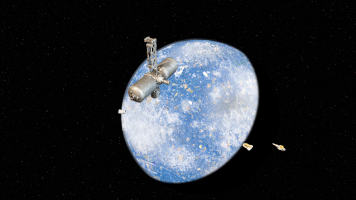
20251217_012750-jumpshuttles (Medium).png
A pair of unidentified jump shuttles approach Ishtar IV

Ishtar’s Star is a red subdwarf with eight planets. The first four are airless worlds. Ishtar III, the smallest of the four inner planets, has a mining settlement. The orbital station has storage and transfer capabilities, and tankage of 10Ktons of MMH and LD.

Ishtar IV was more extensively settled at one time, and may even have been terraformed in the distant past. There is archeological evidence of second wave colonization, though no usable recordings have been discovered. The absence of atmosphere and presence of a continent sized glass sheet suggests a severe cataclysm might have led to the disappearance of this first settlement. More recent colonists mostly arrived in an initial wave of excitement when the archeological remnants were initially cataloged, but that enthusiasm has largely subsided, and the system is comparatively quiet now. It does host a local religious sect, worshipping a deity they associate with the recovery of lost knowledge. There is a small orbital station with tankage for 10Ktons of MMH and LD.

Ishtar V and VI are ice giants. Ishtar VII and VIII are small ice worlds.

The Helene Pocket


HelenePocket (Medium).png

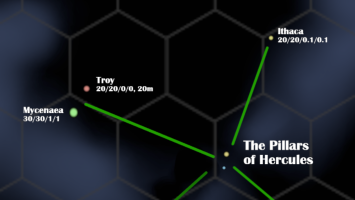
Beyond the Pillars of Hercules lie three systems that might originally have been a part of the Tartarus Rim, but changes in transit space weather patterns have isolated them, leaving them accessible only from the Sickle, so they are now regarded as a part of the Memphian Sector.

Ithaca
Ithaca is a small system with three planets. The innermost planet is the largest settled world. It is principally agricultural, and its climate is almost idyllic. It would doubtless be a resort world if it were not so isolated. There is an orbital station with 20Ktons of bunkerage each of MMH and LD.

Ithaca II is a gas giant with extraction sufficient for local use. Ithaca III is an ice planet.

Mycennae
Mycennae, one of two stars in a broad binary system, has only one planet, a gas giant with a rich mixture of useful isotopes. There are several settled moons, the largest of which has an orbital station with tankage for 30Ktons of MMH and LD.

Troy
The four planets of the Troy system center on a red dwarf. Troy I is a settled, agricultural world. The orbital station has a transfer depot and bunkerage for 20Ktons of MMH and LD. There is a small 20m repair bay.

Troy II and III are gas giants, but extraction is fairly limited. There is some mineral extraction on the moons of Troy III. Troy IV is an ice giant.

. . . . .

It is sincerely hoped by those of us here at Jayne's that these modest entries can help to prevent further strife. We provide military and economic analyses, not to encourage war, but to give those confronting it's shadow a fuller appraisal of its costs and difficulties. Only with a true appreciation of the costs of war can a lasting peace be achieved.
 
Thank you! It's a slow process, but I enjoy the heck out of it. I've fallen down bunches of different rabbit holes doing it at this point, but at the end of the day I'd rather use my own setting for my old lead than the official GW one. Feels like the more oldhammer way to do it, and then when I get done I might even be able to publish my own stories. There are definitely some elements in common with GW, but nothing that's specifically theirs. And more and more all the time that clearly isn't. I won't deny 40K is an influence, but at the end of the day I want to tell my own story of whirring ornithopters and wild eyed heroes, so I'll need my own xenophobic priests and Sardukar legions.
 
Back
Top