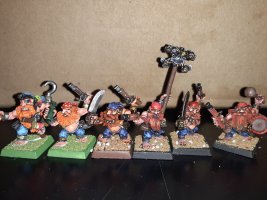
Has Your Technique Changed

I was reading stuff online in various oldhammery type places and noticed that a fair few people use techniques that are new ish (new ish* to me anyway).

When it comes to painting I use pretty much the same techniques as I did in the 80's.
I don't use speed/contrast paints.
I don't do NMM.
I don't zentithal slapchop.

I do use acrylics where initially I used enamels.
But I still paint and blend and mix to get the shadows and highlights.
Inks and washes I use as fine lines or to paint wrinkles/texture thread on clothes, I don't use washes to shade.
I use metallic paints.

In short my painting technique has not incorporated things that have emerged/become more prevalent in later years.
Though I think it is fair to say my ability within my style has improved.

I don't feel the urge to try new methods as I am happy with how I do things.
I am aware that other techniques may increase my output or indeed make for more realistic finishes, but I don't think that is what I want.
I am happy with the same old tried and tested methods from 35+ years ago with the odd improvement here and there until my eyes betray me.
It is comfortable.

Caveat: My basing was only about two types of flock and or painted sand, it is now more advanced with static grass and tufts etc.


I am wondering how many people still use the same methods as back when they started, and if not why not?
And if so, why so?
 
My only real change since the mid 80s has been the introduction of contrast paints tbh. I find they work great as a combined basecoat and wash, saving me a step, as I can then just do edge highlights over the top of them. Tbh I've never seen a NMM paintjob I actually like. I'm sure it's technically impressive, but it's just not for me.

Also, yes to modern basing. No more green sawdust!
 
Interesting thread
I don't feel the urge to try new methods as I am happy with how I do things.
I am aware that other techniques may increase my output or indeed make for more realistic finishes, but I don't think that is what I want.
I am happy with the same old tried and tested methods from 35+ years ago with the odd improvement here and there until my eyes betray me.
It is comfortable.
I'd say that's pretty much myself. I'm not really looking to push myself too much with painting since I want to enjoy it. I'm also not really looking to crank out an army (although maybe I should!) so speed isn't key.

I started with Enamels coming straight off aircraft kits, no significant highlighting or shading.
Moved to Acrylics and did do shading with ink washes, highlighting was mostly dry brushing. That was probably the bulk of my youthful painting
Returned to painting, still acrylics, washes. Switched more to layering highlights with glazes, I drybrush a lot less now.
Refined this somewhat with a bit more edge highlighting, sometimes using airbrushing and contrast paints and a few other "new" (to me) techniques. Finally started varnishing models! I was always a bit scared of the old rattle can varnishes of lore, using the airbrush or even painting it on (which I do when I want a thicker coat) has proved less scary.

Bases started as painted plain (dark) green
Then I'd use model railway ballast or the occasional sand/paint/highlight (but that seemed like a lot of work)
Then flocked with classic sawdust flock when I was doing mostly fantasy armies
These days texture paste, wash and highlight and then static grass and tufts

And for some reason other than my very first all dark green bases I've always liked black edges for my bases, I think I quite like the slight separation or framing it provides or something. Not a fan of green edges! :)

Terrain wise I'd say the one thing I'm actively shifting away from is sawdust based flocks, they just don't hold their colour well enough in UV light and I'm sufficiently slow that I notice it now. I hope nylon static grasses will hold up better, so I'm shifting more to using these as my base layer as opposed to using them as a secondary layer in the past.

I still have a tendency to see someone else's style and think I'd like to do everything just like that. Something like say seeing @Padre's black-lining and thinking damn I want that look, or some of the more "grim dark" weathered looks people do for modern 40k. I did (or am doing) that a bit more on some Night Haunts where I went more colourful than I would naturally. I still like them, but I'm not sure it's "me"! Some of the more comic/cartoon styles can look great, but I've never tried to ape them. I did experiment a bit with Slap Chop when I was doing my Fantasy Regiments orcs/gobs, which was interesting and I was impressed with how good it can look without the need for a lot of care, but I switched back to my conventional layering when I did the next goblinoids. Never tried NMM, but I do often add a few forced highlights on my metallics these days.

I did post a then and now for a Squig Hopper I painted a while back. You'll have to forgive that I forgot to paint the fingernails and skulls on the belt cord. Also the skin highlight do get a little flattened in camera, but it shows the change in style since youth.
 
And for some reason other than my very first all dark green bases I've always liked black edges for my bases, I think I quite like the slight separation or framing it provides or something. Not a fan of green edges!

Same, I think for me it started when I saw black bases in WFB 3rd and decided that as the models don't blend with the table on account of them being on big plastic chunks there is no point in trying to hide it with a green edge?
Tis also why my 10mm movement trays had the front edges the same colour as their uniforms.
Dunno.

For what it is worth I prefer the look of the "switched back to my conventional layering when I did the next goblinoids. "
 
Last edited:
Probably a familiar tune, but I started with enamels. (Model railroad enamels in my case. Mostly Floquil.) Initially it was pretty much block painting, but then I stated drybrushing on top of black base coats for camouflage effects. In the late 80s I began drybrushing most things for highlights, and basing everything in black, which I still do today. In the late 90s I started using craft acrylics like Apple Barrel, which is still my paint of choice today. Right around the turn of the century (ouch!) I began using Windsor Newton inks for washes. I also started wet blending a little around that time, since it was easy to blend acrylics with the ink before it dried. I tried out a wet palette for a little while, but it didn't stick. I've dabbled with splatter painting a little, but it's a special technique, not a go to. I also sponge paint scenery and vehicles sometimes. (That since the mid 80s or so.) The most recent change is actively using an artist's palette and blending on the palette, though I still also wet blend on the miniature some. I tried airbrushing in the 80s, but I found it way too much hassle and I didn't care for the effects. I use a black rattle can sometimes to base coat large things like buildings and vehicles, and I use rattle can varnish, but that's the only spray painting I do. No slap chop. No zenithal highlight. No OSL. No NMM. No speed paints. Just not into the trendy stuff, even if what other people get looks good sometimes. I just feel like it wouldn't fit with my own collection. I'll stick to my "paint it black" techniques for the rest of my life, I expect. It works for me, even if nobody else cares to do it that way. Maybe someone will twist my arm enough to try something different once or twice, but I've invested enough time and treasure in the way I do it now I don't expect anything other than a small incremental change would stick.
 
My 'technique' has definitely changed. But that's mostly to do with the fact I stopped painting when I was around 16 or 18 and didn't pick it up again until last year, about 30 years later. I've definitely got more patience and better paint, and as I don't really have much opportunity to play, I don't need a painted army, so I try to make each mini the best I can. I thin paint now, which I didn't really do before. I think by the end of my teens I was undercoating, but it clearly didn't feature much in my earlier painting. I do use some speed paints, but tend to thin them as washes. I may have just started using shading towards the end but the most it really got was a bit of dry brushing (which I'm still awful at and need to practice - but I can't get on with these new fluffy dry brushing brushes).

So my technique has definitely changed but that's mostly due to improving my skills I think, but my style is still firmly rooted in the late 80's/early 90's. Slap chop and zenithal highlights just don't appeal.
 
Last edited:
My technique changed a lot:
- basically, it now comprises the use of zenithal lighting and the colour theory (using contrasting colour in the shadows in order to enhance and enrich the base colour);
- I completely lost any drybrushing skill, even when it comes to drybrush the soil on a base;
- it involves the use of all the other mediums in addition to acrylics in order to get better effects, such as dirt, weathering, oxydation, moisture.

Generally speaking I don't use "technical" or "speed" paints, such as contrast/washes, as they're intended, but I incorporate them in my technique in order to add something to regular paints.

I still wouldn't touch NMM with a barge pole because:
A) I've seen it - done the by best in the business - in real life and I can't stand it;
B) I, for the life of me, can't understand where lights and shadows should be placed on anything I'm painting
 
Last edited:
Back
Top